





You add a second model. Then a fallback. Then budgets, guardrails, and audit logs.
Somewhere along the way, the stack acquires a proxy, a router, and a gateway.
Sometimes as separate components, sometimes bundled into one platform.
That overlap makes infrastructure decisions harder than they should be.
A tool sold as a gateway may mainly abstract provider APIs.
A router may optimize model selection without enforcing access policies
A proxy may forward traffic reliably but leave governance to another system
The useful distinction is the responsibility each layer owns.
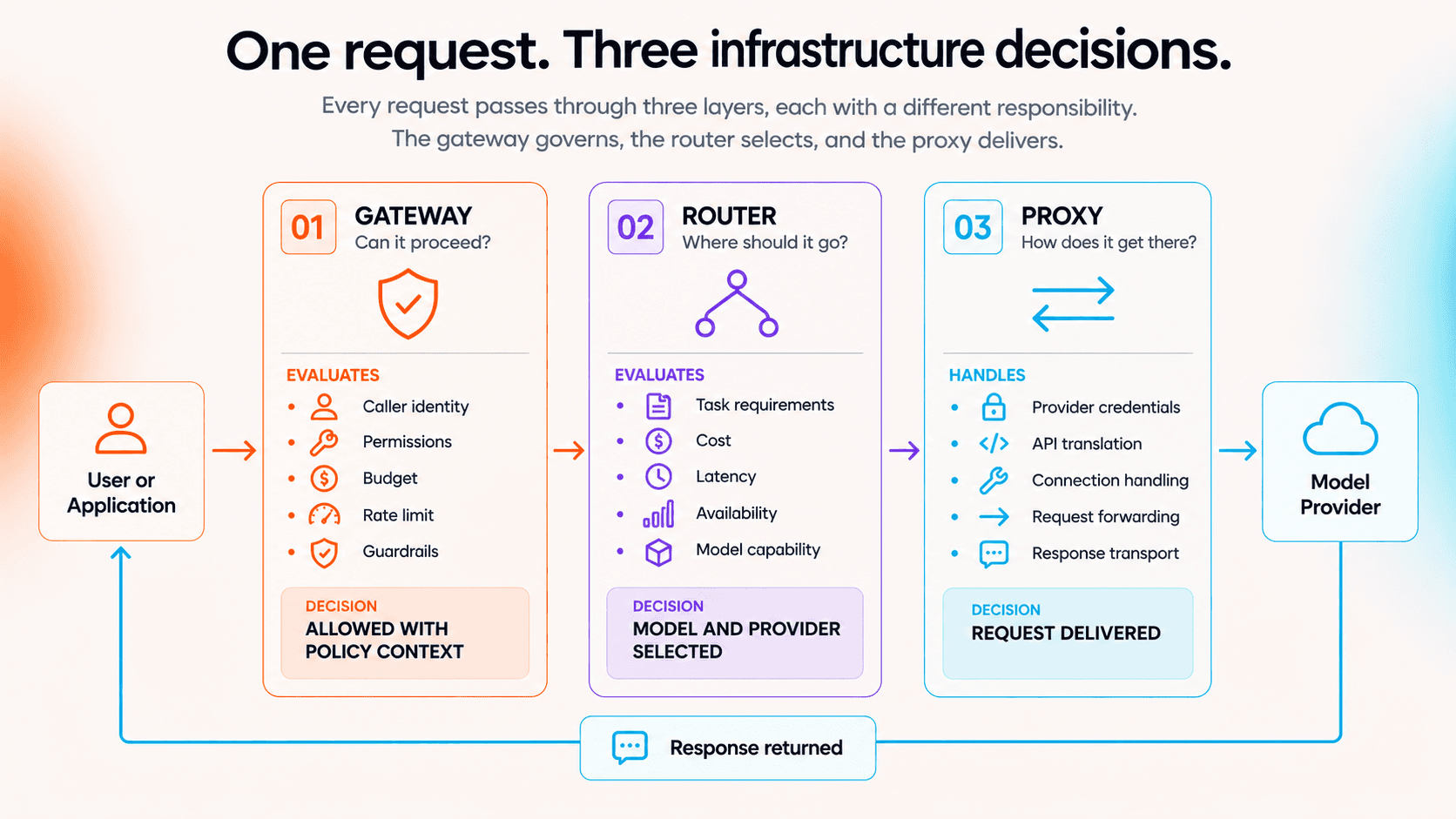
A proxy moves the request, a router decides where it goes, and a gateway controls whether it should proceed.
These are responsibilities, not necessarily separate products.
One platform may perform all three, though each decision still needs a clear owner.
Proxy, router, and gateway compared by responsibility
Each layer owns a different decision.
A proxy handles delivery, a router chooses the destination, and a gateway applies the rules around access and usage.
Proxy | Router | Gateway | |
Primary responsibility | Forward requests between applications and providers | Select the model or provider for each request | Enforce identity, access, budgets, and policy |
Core question | How does this request reach the provider? | Where should this request go? | Is this request allowed, and which rules apply? |
Operational focus | Provider abstraction, upstream credentials, connection management, and request forwarding | Cost, latency, availability, capability, and quality-based selection | Virtual keys, permissions, rate limits, budget controls, guardrails, and auditability |
Context used | Request and connection details | Request metadata plus model and provider performance | Caller identity, application context, policy, and usage |
Typical owners | Platform and application engineering teams | AI platform and ML engineering teams | Platform, security, compliance, and engineering leadership |
Usually introduced when | Direct provider integrations begin spreading across services | One model or provider can no longer meet every workload requirement | Multiple teams share infrastructure or governance requirements increase |
These responsibilities can live in separate components or inside one platform.
The architecture becomes easier to evaluate once your team asks whether each job is covered.
Proxy, router, and gateway solve three different infrastructure problems
Products often bundle these functions together, but the underlying responsibilities remain distinct.
The proxy handles transport: provider abstraction, upstream credentials, connection management, and request forwarding.
The router handles selection: choosing a model or provider based on cost, latency, availability, or capability.
The gateway handles control: applying identity, access policies, budgets, rate limits, guardrails, and audit requirements.
Consider whether each responsibility is covered and whether the layers share enough context to make consistent decisions.

An LLM proxy standardizes provider access and request transport
An LLM proxy moves much of the provider-specific integration logic out of the application layer.
Services send requests to one endpoint, while the proxy handles the connection to whichever provider sits behind it.
That becomes valuable as the model stack expands.
Without a proxy, authentication and connection logic tend to spread across services. A provider change then becomes a code change in several places rather than an infrastructure decision made once.
The proxy centralizes that transport layer. It manages upstream credentials and gives platform teams one place to observe provider calls. Its responsibility ends at delivery.
At Orq.ai, we think a proxy has failed as an abstraction when engineers must bypass it to understand a provider incident. Simplification should reduce integration work without erasing the evidence needed to diagnose failures.
Choosing the right model for a request belongs to the router. Applying governance policies belongs to the gateway.
An LLM router selects a model according to workload policy
It uses request context and routing policy to select a model or provider. A proxy may then handle delivery, even though both responsibilities often live in the same platform.
For one request, it may mean the cheapest model that clears a quality threshold. For another, it may mean the provider with the lowest current latency or the only model that supports the required context window.
Cost-aware routing reduces unnecessary model spend
Many production workloads contain requests that do not require frontier-level reasoning.
The savings comes from matching model cost to task difficulty. Routing every request to the strongest available model wastes budget.
Routing too aggressively introduces quality regressions. We find that successful teams validate cheaper routes against representative evaluations before moving production traffic.
Latency-aware routing avoids degraded providers
Provider incidents are rarely binary. Latency often rises before requests start timing out.
A latency-aware router can use current provider telemetry to shift traffic once performance crosses a defined threshold.
That keeps slower providers from becoming a bottleneck while preserving them as options once performance recovers. The routing policy should include clear thresholds so traffic does not bounce between providers in response to short-lived spikes.
Capability-aware routing matches requests to model constraints
Some requests require features that only a subset of models can support. A long document needs enough context capacity. A tool-using workflow needs reliable function calling. Structured extraction may depend on schema-constrained output.
The router filters out models that can’t satisfy those requirements before optimizing for price or speed. Otherwise, a cheaper route can fail for reasons that have nothing to do with model quality.
Our position is that a fallback is only reliable when it preserves the workflow contract. Returning a response isn’t enough when the replacement model breaks tool use or the output format expected by the application.
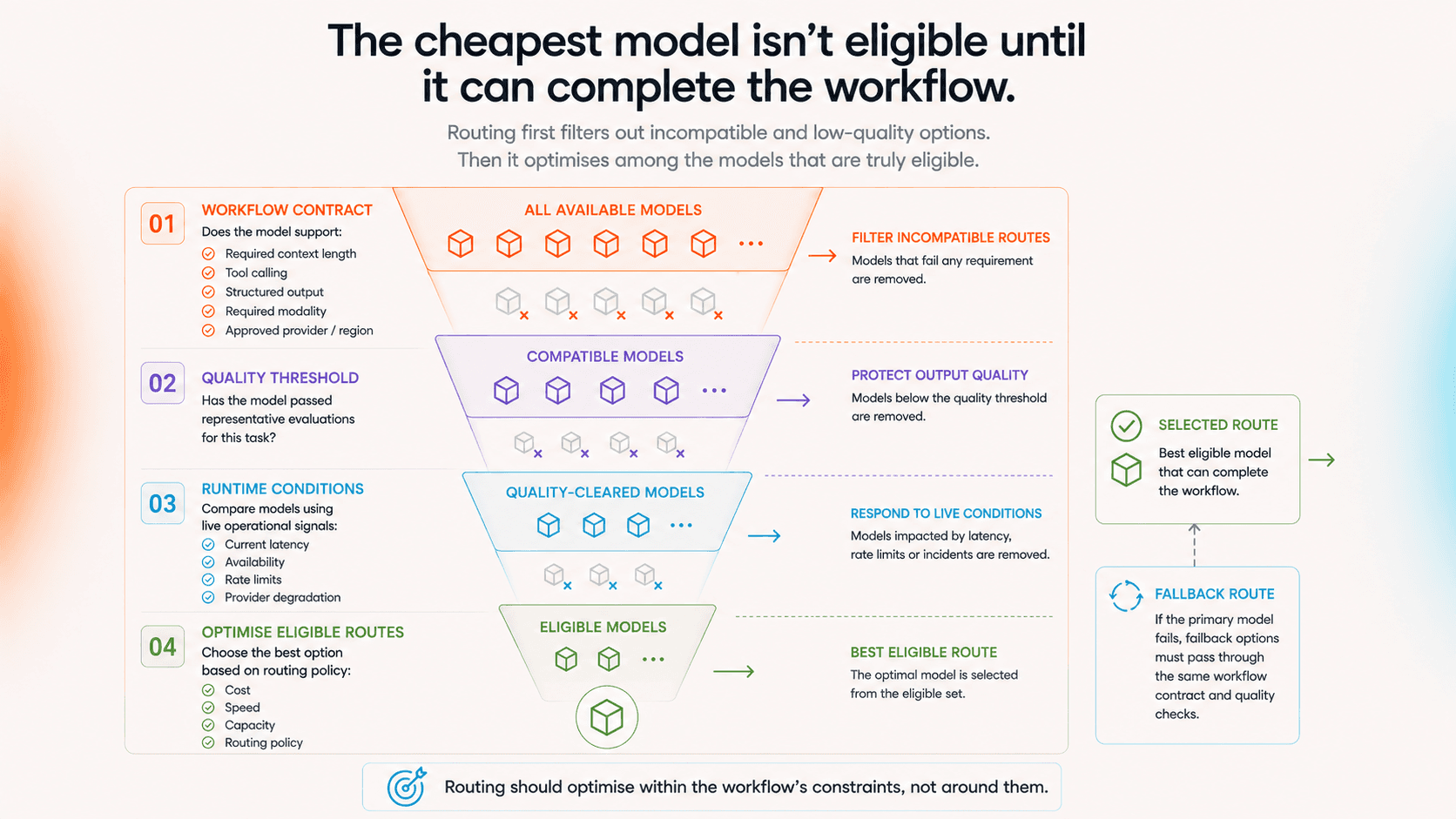
Routing owns destination selection.
The proxy carries the request once that choice has been made, while the gateway determines which models and providers the caller is permitted to use.
An LLM gateway enforces identity, budgets, and policy
A gateway decides whether a request can proceed and which constraints apply to it.
It uses caller identity to enforce controls before traffic reaches a model provider, not just the request payload.
That difference becomes important once several teams share the same AI infrastructure. A proxy can forward their requests, and a router can choose where those requests go.
Neither function alone tells you who generated the spend.
Virtual keys separate provider credentials from application access
Applications authenticate through scoped virtual keys rather than holding provider credentials directly. The gateway maps each key to the relevant team or workload, then applies the permissions attached to that identity.
Platform teams can rotate upstream credentials without updating every service. They can also revoke one application’s access without disrupting the rest of the stack.
Rate limits and budgets control consumption
Shared access needs enforceable boundaries. A gateway can limit requests by user or team. It can then reject traffic once a defined threshold is reached.
Budget controls work the same way.
Instead of discovering an overspend at the end of the month, teams can cap usage at the point where requests enter the system.
The router may still choose the most economically eligible model, though the gateway determines whether the caller has permission and budget to use it.
Gateway guardrails can enforce shared prompt and output policies
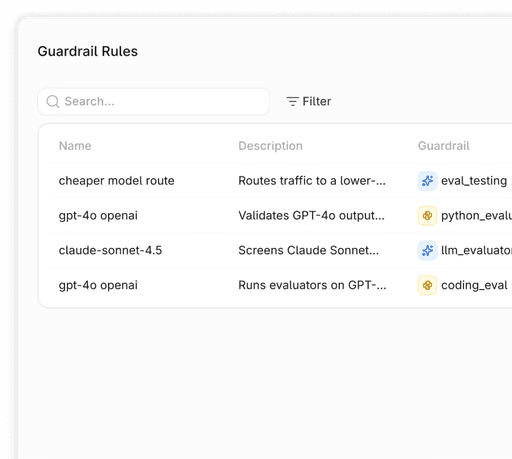
The gateway is a natural enforcement point for controls that should apply consistently across applications.
These may include:
PII detection
Model allowlists
Content moderation
Restrictions on which data can be sent to a particular provider
Central enforcement reduces the risk of every product team implementing the same policy differently. It also makes changes easier to govern. Update the rule once, then apply it across the workloads covered by that gateway.
Audit logs connect every request to an identity
Governance requires more than a record that a request occurred.
Teams need to know who sent it, where it was routed, and what it cost.
A gateway attaches that identity and policy context to each request. The resulting audit trail supports cost allocation without forcing teams to reconstruct activity from disconnected provider logs.
These responsibilities need shared context
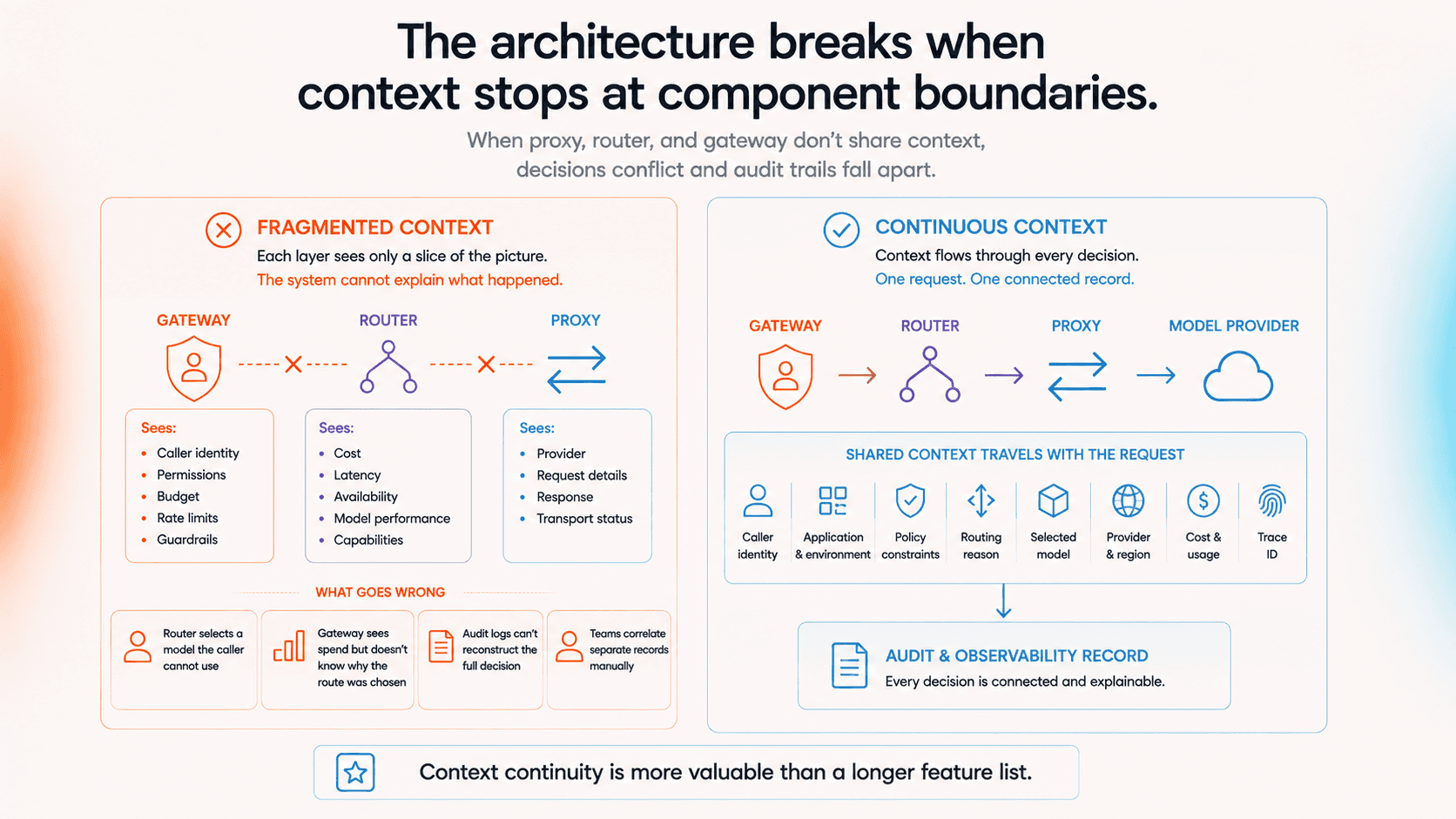
The architecture breaks down when each layer sees only part of the request.
A router may know which provider is cheapest or fastest, but not whether the caller is permitted to use it. A gateway may enforce a budget without knowing why the router selected a more expensive model.
Strong implementations preserve context across the request path.
Caller identity and policy constraints inform routing. The selected model and provider flow into cost attribution. A shared trace connects the original request to every routing decision.
We think context continuity is more valuable than an impressive feature list. Strong capabilities still produce a weak operating model when identity and routing decisions can’t be reconstructed together.
Evaluate platforms by responsibility, not product label
Vendor categories are unreliable because most products now span several layers. Product names reveal less than the decisions a platform can own.
Start with the responsibility your stack needs, then examine how context moves between the capabilities it combines.
On the other hand, a proxy may also include routing and observability.
Evaluate proxy capabilities
Start with the integration boundary. The proxy should give applications a consistent way to reach providers while handling the differences that still exist between their APIs.
Check how it manages:
Retries
Timeouts
Credentials
Provider-specific errors
Then test what happens when an upstream provider degrades or the proxy itself restarts. A useful abstraction reduces integration work without hiding the information engineers need to debug failures.
Evaluate routing capabilities
A router should make decisions that you can explain without rewriting application logic.
Inspect which signals drive model selection.
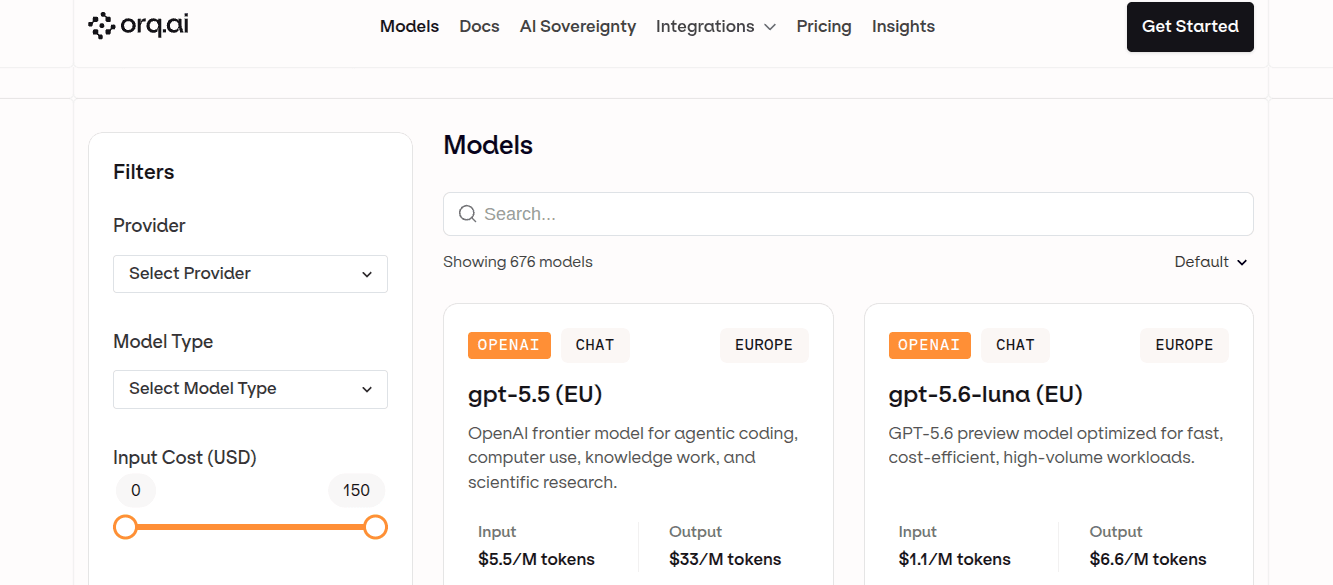
These may include:
Cost
Latency
Task type
Availability
Context length
Model capability
Pay equal attention to fallback behaviour.
How quickly does the router react to partial degradation, and how does it avoid retry loops or unstable switching between providers?
For cost-based routing, confirm that teams can compare quality as well as spend. A cheaper route only works when the selected model still meets the required standard for that workload.
Evaluate gateway capabilities
Evaluate gateway controls from the caller outward.
The platform should know which user or environment generated a request before it applies policy.
Check whether teams can set model permissions at the right level of granularity.
Audit records should connect each request to the caller and the resulting cost.
The gateway should make shared infrastructure accountable without requiring every application team to recreate the same controls.
Evaluate the platform as a whole
Strong features can still produce a weak system when identity and routing remain disconnected.
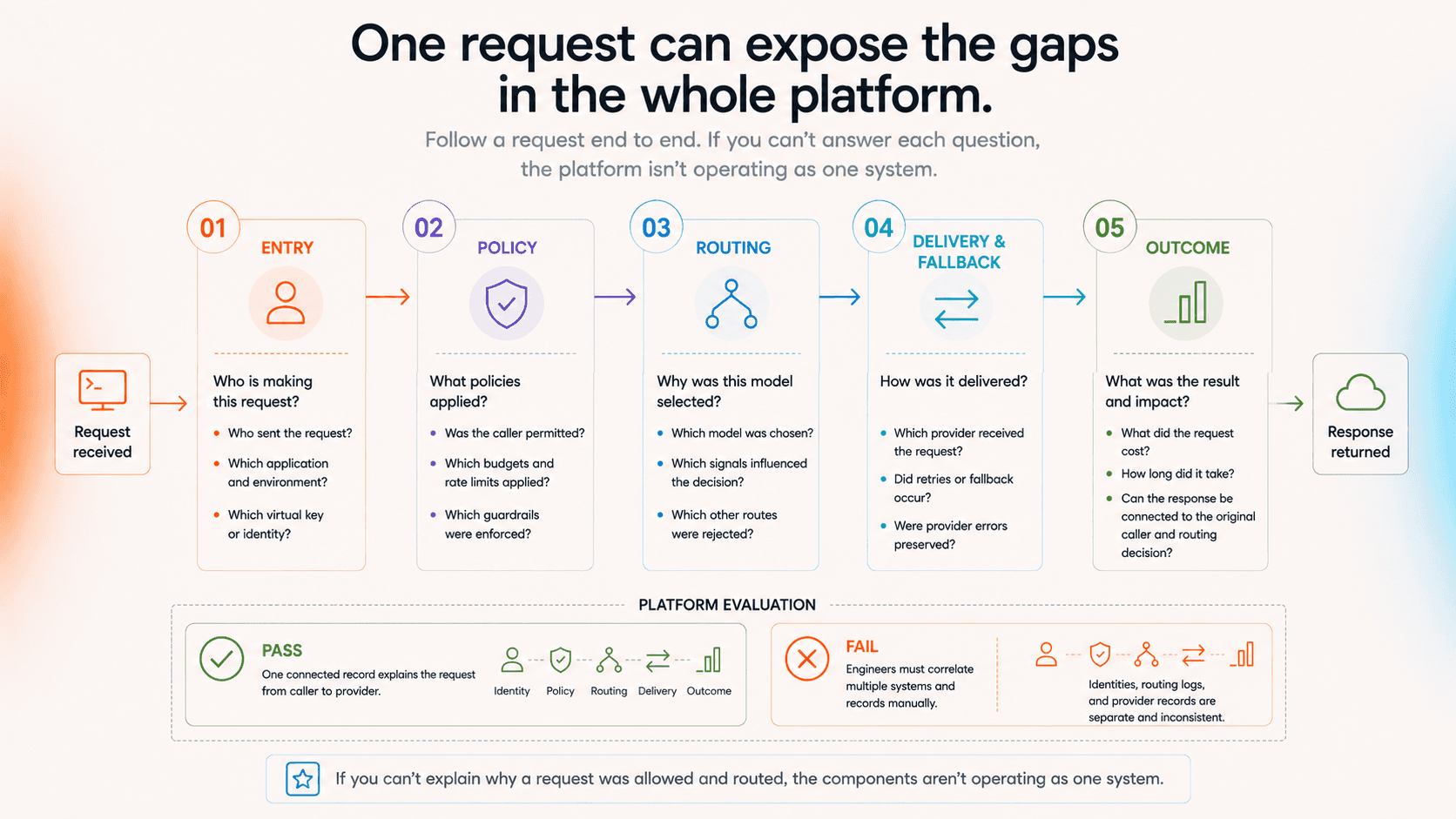
Trace one request from entry to provider response. We believe the fastest way to expose architectural gaps is to follow one real request through the platform.
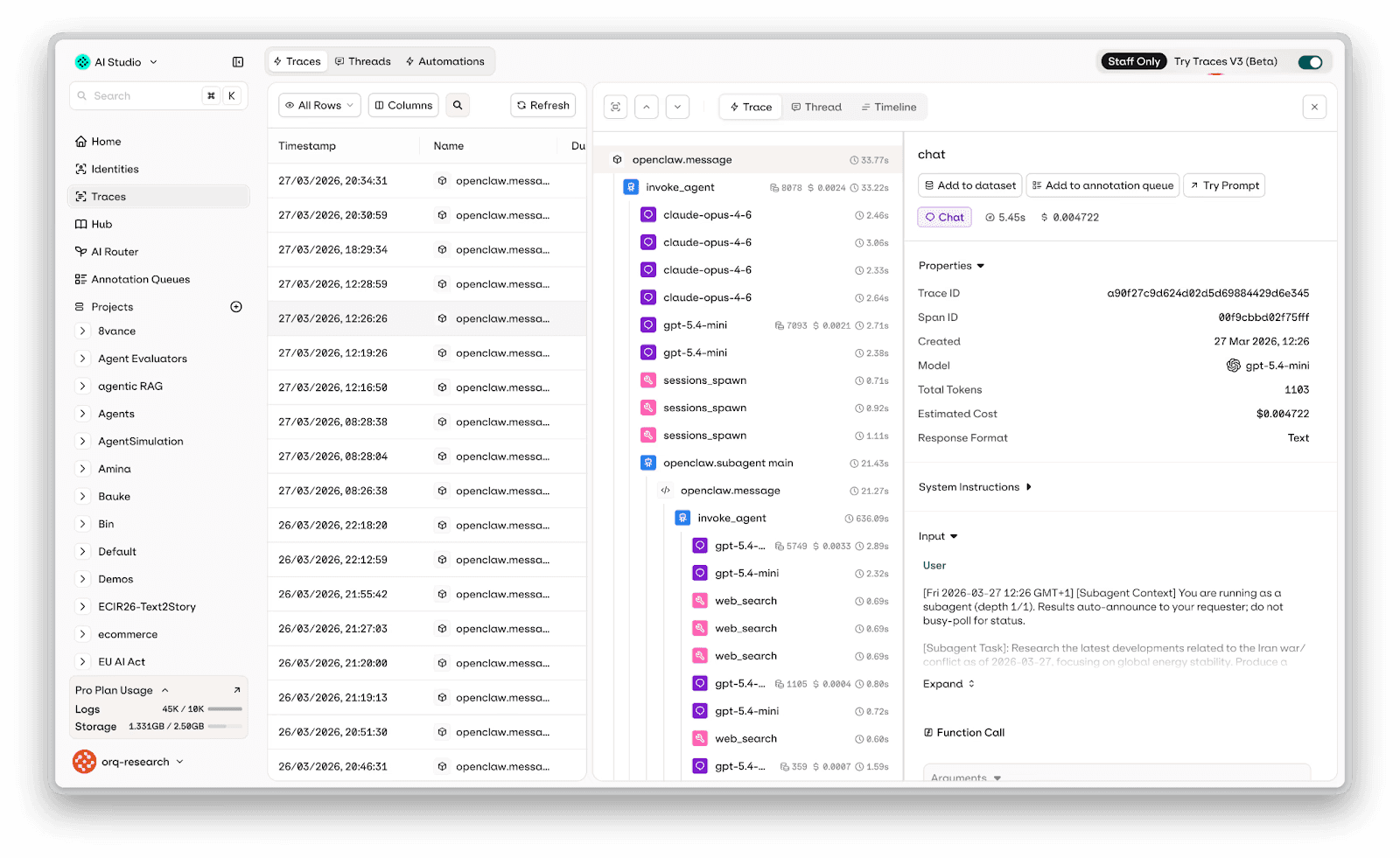
If you can’t explain why that request was allowed and routed, the individual components aren’t operating as one system.
You should be able to see:
Who sent it
Which rules applied
What the request cost
Why a route was selected
Whether any fallback occurred
Assess the operational burden as well.
Separate tools may offer deeper control in specific areas, while an integrated platform can reduce the work required to connect metadata and telemetry.
The better choice is the one your team can operate reliably.
Choose the responsibilities your stack needs, not the label on the product
The architecture proves its value when the system behaves unexpectedly.
At that point, your team needs one record that explains the decision from caller to provider.
Buy for that operating model, not the category printed on the product page.
Orq.ai keeps routing decisions connected to gateway policy and observability, so you can change model strategy without losing the context behind each request.
See how Orq.ai’s AI Gateway works in practice.