Sovereign AI. From infrastructure to software.
Operate models, agents and autonomous software delivery under the jurisdiction you choose, on infrastructure you control.
100%
In-region data residency
94%
Sovereignty Score
EU
European owned
Mission-critical for European teams at





The law
Why an EU data center is not enough
Sovereignty is set by the law your provider answers to, not by where the servers sit. Two US statutes reach data held by US companies anywhere in the world, and EU law now pulls in the opposite direction.
SOVEREIGNTY HAS CHANGED
Controlling your data is no longer enough.
You need to control what AI can access, decide, change and build AI used to mean sending prompts to a model. Now agents access your systems, use tools, modify code and increasingly build software.

THE SOVEREIGN APPROACH
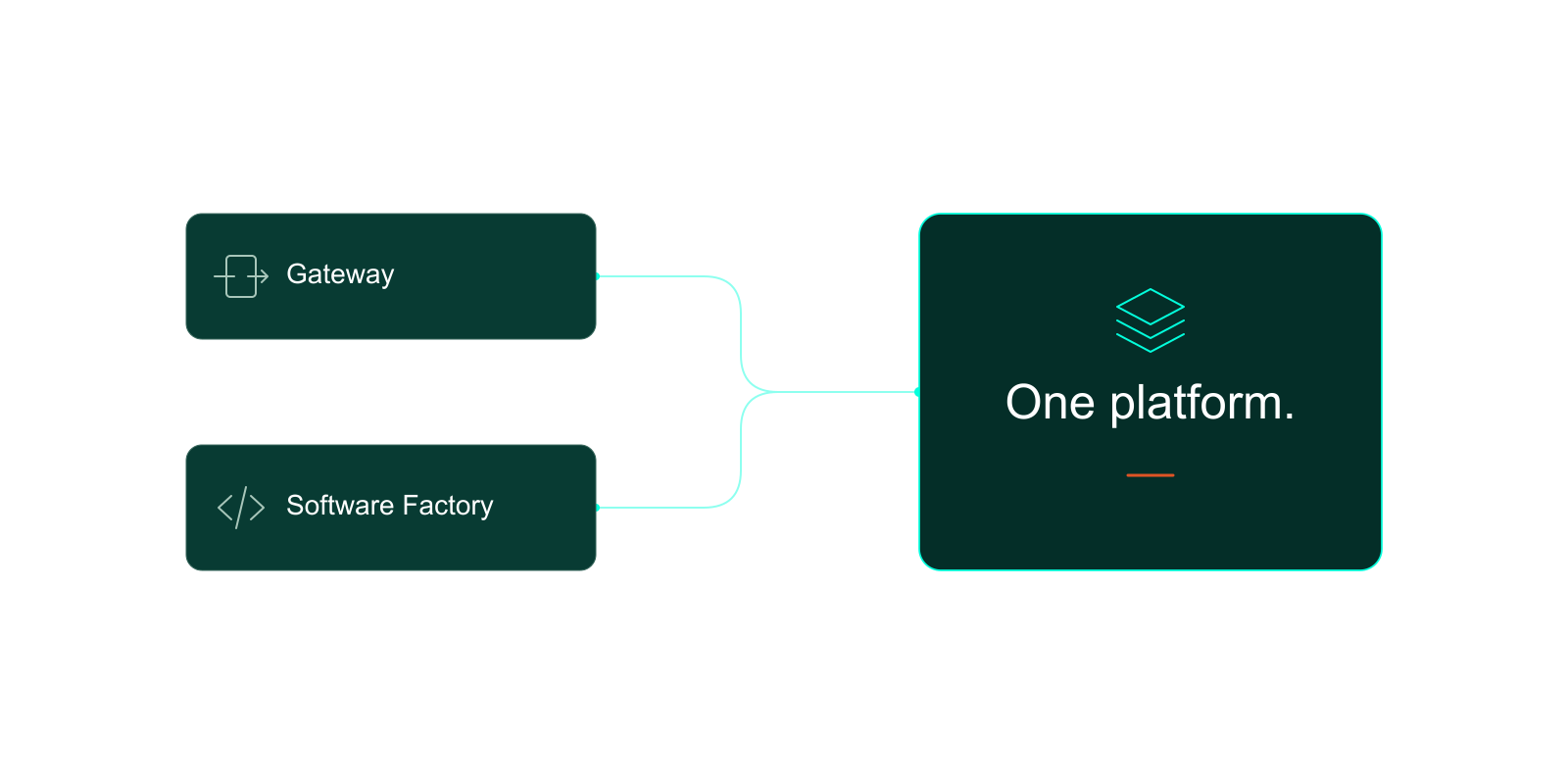
Two paths. One sovereign platform.
Control the AI you operate and the software your agents produce from one sovereign control plane.

GOVERNED AUTONOMY
Your software supply chain is becoming autonomous.
Autonomous agents can plan, build, test and improve software. Orq.ai keeps that process governed and human-controlled where it matters.

SOVEREIGNTY BY DESIGN
One control plane. Your jurisdiction.
The same sovereign controls govern your models, agents, tools, code and data.

DEPLOYMENT SOVEREIGNTY
You decide where it runs.
From AI traffic to autonomous software production, the control plane stays where you decide it belongs.

EU Cloud
European infrastructure.

Your Cloud
Inside your own cloud environment.

On-prem
Your infrastructure.

Ari-gapped
No external connection.
European by Design
Sovereignty isn't a hosting option.
Orq.ai is built, owned and operated in Europe.

FAQs
What enterprises ask us about AI sovereignty
How is Orq.ai different from a US vendor with EU data centers?
Data stored in EU regions by a US company is still subject to the CLOUD Act: US authorities can compel access regardless of where the data is physically stored. Orq.ai is an EU entity with an EU cap-table. No US parent company means no CLOUD Act jurisdiction. Your vendor’s nationality is what determines which law applies, not the location of the servers.
Does EU sovereignty cover the full platform or just the gateway?
All four pillars (AI Gateway, AI Observability, AI Engineering, and AI Governance) run on EU infrastructure under EU law. This is different from vendors that offer EU data residency as an add-on for specific products while running the rest of their platform under US jurisdiction.
What is SEAL-4 and why does it matter?
SEAL-4 is the highest Sovereignty Effectiveness Assurance Level under the EU’s Cloud Sovereignty Framework. It requires that no third country exercises effective control over the design, development, maintenance, or evolution of software components. No provider operates at that level at scale today. Orq.ai is built to move you toward it, with EU ownership, EU infrastructure, and supply chain transparency already in place. Full detail on CADA and the SEAL levels is on our EU sovereignty page.
How does Orq.ai support DORA compliance?
DORA requires financial institutions to demonstrate operational resilience for digital and AI systems. Orq.ai’s EU Sovereign Cloud deployment, audit logs, incident alerting, and governance controls are built to support DORA obligations directly.
Can Orq.ai deploy on our own infrastructure?
Yes: cloud, EU sovereign cloud, or fully air-gapped on your own servers with no egress and no telemetry. Air-gapped deployment achieves 94% on the EU Cloud Sovereignty Framework.
Can you support data residency in our region?
Yes. Orq.ai runs as managed SaaS, inside a sovereign cloud environment, or fully air-gapped on your own infrastructure, so processing and storage stay in the region you choose. Talk to us about the region and deployment mode you need.
Can you support data residency in our region?
Yes. Orq.ai runs as managed SaaS, inside a sovereign cloud environment, or fully air-gapped on your own infrastructure, so processing and storage stay in the region you choose. Talk to us about the region and deployment mode you need.
We are not based in the EU. Does any of this apply to us?
Yes. Sovereignty is a question about jurisdiction, not geography: whichever government has authority over your provider can compel access to your data, wherever the servers physically sit. Orq.ai operates as a single European entity, and deploys into your own cloud or fully air-gapped on your own servers, so you can put the control plane inside whichever jurisdiction you answer to.
We are not based in the EU. Does any of this apply to us?
Yes. Sovereignty is a question about jurisdiction, not geography: whichever government has authority over your provider can compel access to your data, wherever the servers physically sit. Orq.ai operates as a single European entity, and deploys into your own cloud or fully air-gapped on your own servers, so you can put the control plane inside whichever jurisdiction you answer to.
Does the EU have its own version of the CLOUD Act?
Not a mirror of it. The EU e-Evidence Regulation (2023/1543), applying from August 2026, lets an authority in one member state order a provider offering services in the EU to produce electronic evidence, but it stays inside EU judicial oversight. GDPR Article 48 blocks third-country orders that do not come through an international agreement, and Article 32 of the Data Act requires cloud providers to prevent unlawful third-country government access. The EU legislates against extraterritorial reach rather than claiming it.
Why does it matter where your AI vendor is headquartered?
AI infrastructure is increasingly subject to geopolitical pressure. Models get restricted overnight, export controls shift, and US law can compel access to data held by US-owned companies regardless of where it’s physically stored. Building on a European vendor means your AI stack isn’t exposed to those risks: your contracts, your data, and your governance all sit under the same jurisdiction.
It's who controls what AI builds.
Control the AI you operate. Control the software your agents produce. One sovereign platform for both.