






Cutting LLM spend is straightforward, protecting quality isn’t. Most stacks can lower their invoice quickly by moving traffic to cheaper models and turning up caching. The numbers improve, which makes those changes feel obviously right.
The risk is that all of those levers are product decisions disguised as cost controls.
A cheaper model may miss nuance. A shorter prompt may drop the guardrails that kept answers grounded. A cache hit may serve something that used to be correct but no longer is.
None of that shows up in token graphs, so it’s easy to optimize for what’s visible and slowly erode what users actually experience.
Our view is that gradual quality loss is harder to manage than a clear outage. An error spike gets investigate. A slightly worse answer can remain in production for months.
An LLM cost saving is only real if quality holds
LLM spend shows up everywhere. Invoices, usage dashboards, token graphs.
Those numbers are concrete, easy to track, and simple to optimize. What rarely gets equal treatment is the behavior of the system itself. Whether the answers stay useful as you ratchet those costs down.
When changes focus only on spend, quality tends to erode in slow motion. Traffic shifts to models that miss edge cases. Shorter prompts remove the one instruction that kept outputs aligned with policy.
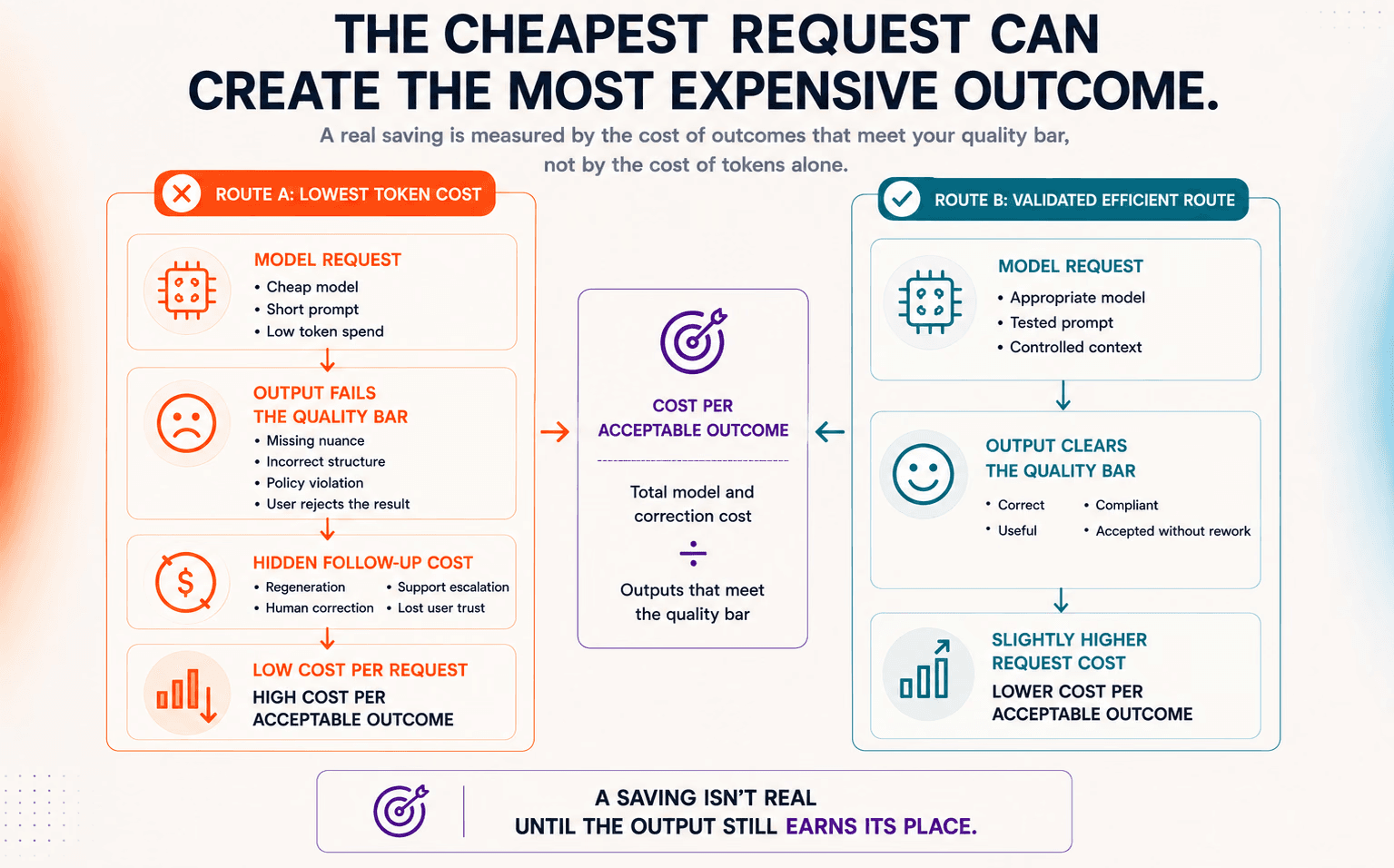
The standard for a genuine saving is stricter than “the bill went down.” A cheaper configuration has to meet the same quality bar on the workload that matters to your team.
At Orq.ai, we think cost per acceptable outcome is a more useful measure than cost per token.
Cheap requests create no value when they produce work that has to be corrected or generated again.
Four cost levers can reduce spend without degrading output
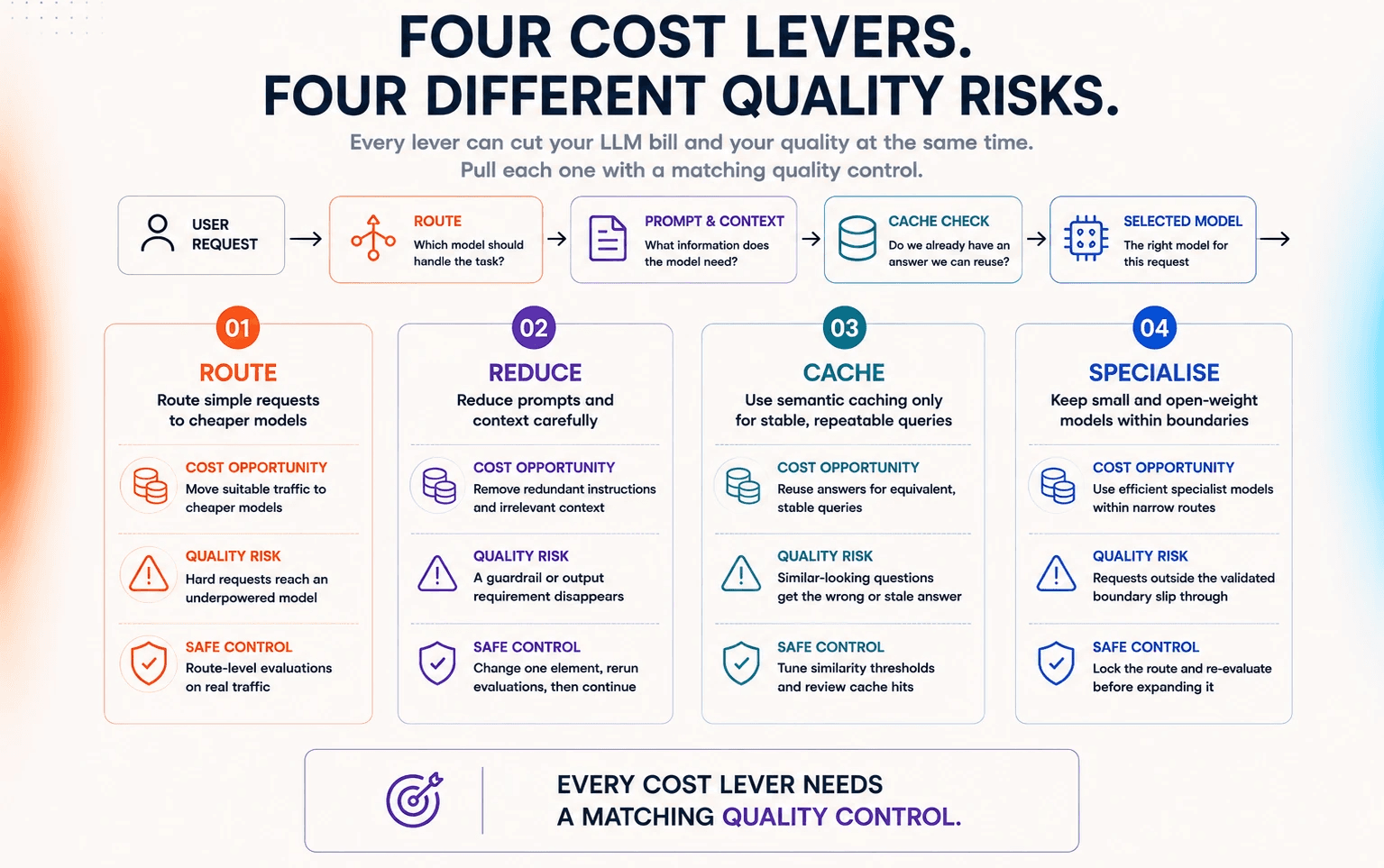
Four controls drive most of an LLM bill.
Each one affects cost and quality at the same time, so you need a way to pull them without damaging behavior on real workloads.
1: Route simple requests to cheaper models
Start with routing. Frontier models often cost an order of magnitude more per token than strong mid‑tier models, yet a large share of production usage involves work that doesn’t need frontier‑level reasoning.
Guesswork is where routing goes wrong. Label a request “simple” by instinct and you eventually push harder queries onto models that aren’t built for them. Experienced teams build a compact evaluation set from actual production traffic, including accepted outputs.
Only when the cheaper model consistently meets the defined quality bar for a specific task does that task move over.
Routing becomes an ongoing experiment, not a one‑time cut.
In FrugalGPT’s experiments, routing queries across different LLMs matched the best individual model’s performance with up to 98% lower cost.
2: Reduce prompts and context one change at a time
Prompt and context length is the next lever. System messages that sprawl and oversized RAG contexts all pump up input tokens, which turns directly into spend.
Cleaning that up can deliver big savings.
Random pruning is the failure mode. Remove multiple pieces of prompt or context at once and you lose track of which change caused a regression, or whether a critical guardrail silently disappeared.
A safer pattern is to cut in small, controlled steps:
Drop a specific instruction or slice of history
Rerun your evaluation set
Only proceed if the outputs stay within acceptable bounds
In many cases, stripping padding and loosely related material actually helps the model focus on what matters.
At Orq.ai, we don’t treat every token as equally expendable. Ten lines of redundant context may add nothing, whereas one short instruction can be carrying the entire output contract.
3: Use semantic caching only for stable, repeatable queries
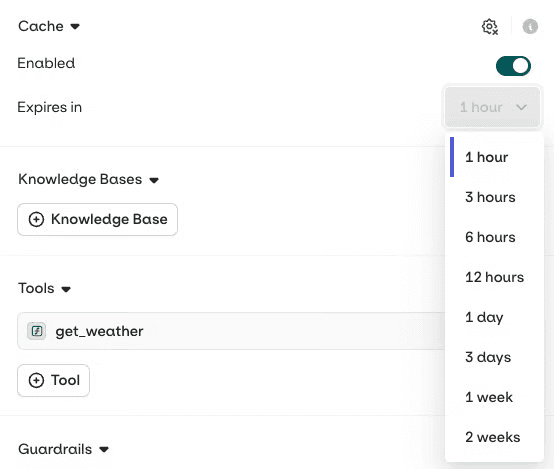
Semantic caching is the third lever, and it behaves differently from routing or prompt cuts. You’re not changing what the model can do; you’re deciding when you can safely skip calling it at all.
In many enterprise applications, a surprisingly large slice of traffic boils down to the same question asked in slightly different ways, which makes this lever worth the effort.
The core design decision is where you draw the line for “similar enough.” Set the similarity bar too low and you’ll serve answers that look right but don’t quite match what the user asked.
Push it too high and your cache barely ever hits, so you keep paying full price.
Successful teams treat this threshold as a parameter to be tuned on real traffic.
They review cache hits regularly and adjust until the cache is only firing on truly interchangeable queries.
4: Keep small and open-weight models inside validated task boundaries
Smaller and open‑weight models are where a lot of real savings hide. Frontier models can cost substantially more than capable mid-tier alternatives, even when the workload doesn’t require their full reasoning capacity.
The safe pattern is to treat these models as specialists. Define a clear task boundary, build evaluations on that exact workload, and route only those requests through the smaller or open‑weight model. Lock that scope in code.
Any time you want to expand what the model handles, run a new round of evals against the expanded task first.
We find the greatest risk with smaller models sits at the boundary of the route, not at its centre. They often perform well on the task they were validated for and fail on requests that only look similar.
Build the evaluation loop before changing cost controls
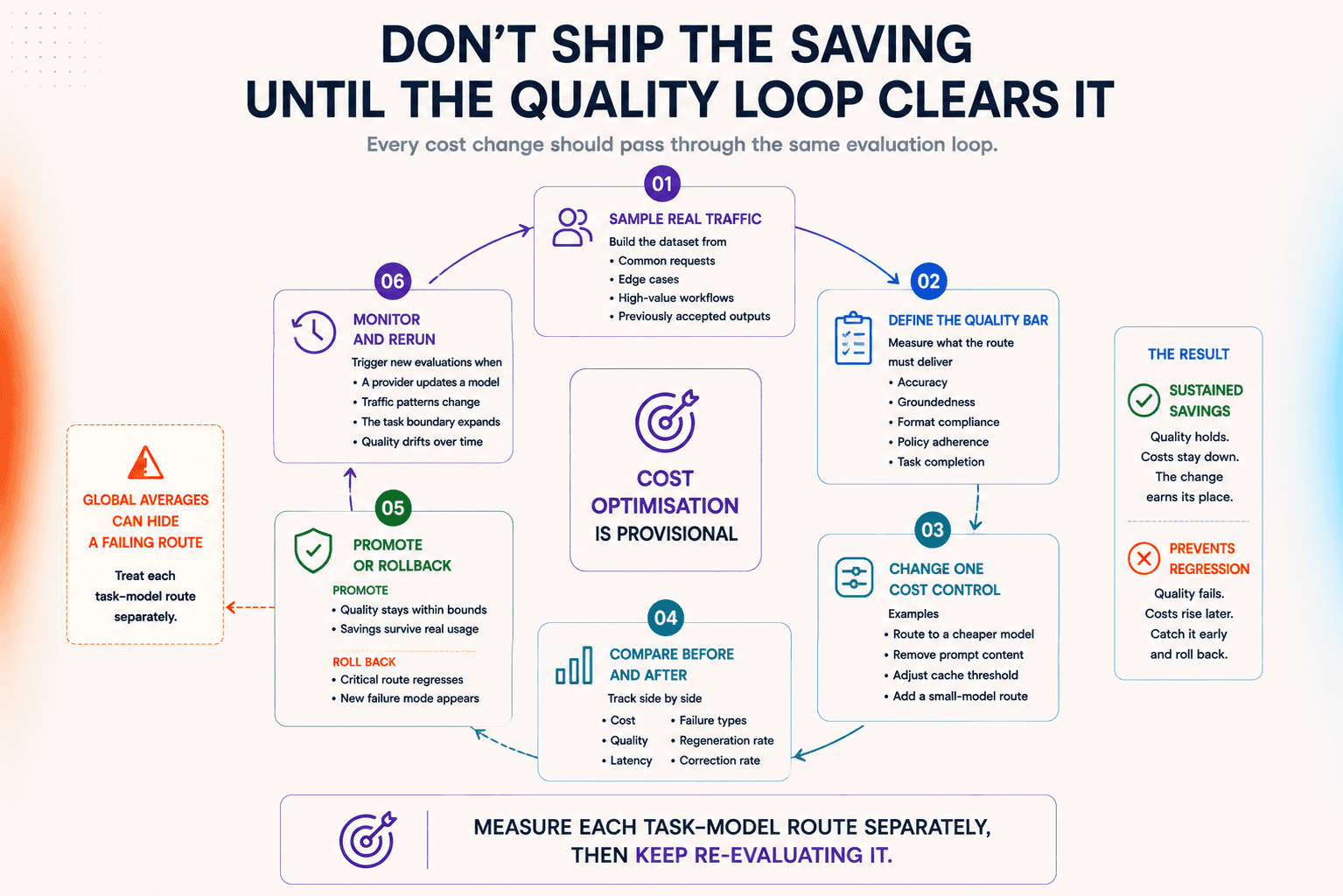
The cost levers only work if you know what they did to quality. Before you route traffic differently or strip out tokens, you need a way to see whether the answers on real workloads stayed within your acceptable range.
Build the evaluation set from real production requests
Begin with a small but representative set of real requests, not synthetic prompts. Pull a few hundred examples from live traffic and attach outputs that you consider a good standard for each one.
That becomes your initial reference set. We believe public benchmarks describe general model capability, not fitness for your application.
A model can lead a leaderboard and still mishandle the output constraints your users bring to production.
It'll be more disordered than a public benchmark and far more relevant.
Because it reflects how your stack is actually used.
Define quality and measure it separately for each route
Aggregate numbers hide trouble. A global quality score can stay flat while one critical route degrades, since strong performance elsewhere offsets the drop. Instead, treat each combination of task and model as its own unit and track quality separately.
Compare results before and after each routing change so a regression can’t disappear inside the overall average.
Re-run evaluations as models and traffic change
An eval loop isn't a one‑off launch checklist.
Base models get updated without much warning, The mix of queries hitting each route changes over time. A routing decision that made sense in the spring can be wrong by the fall.
The only way to stay ahead of that drift is to run evaluations regularly, watch for changes in both quality and failure modes, and treat any cost optimization as provisional until it has survived a few cycles of real usage.
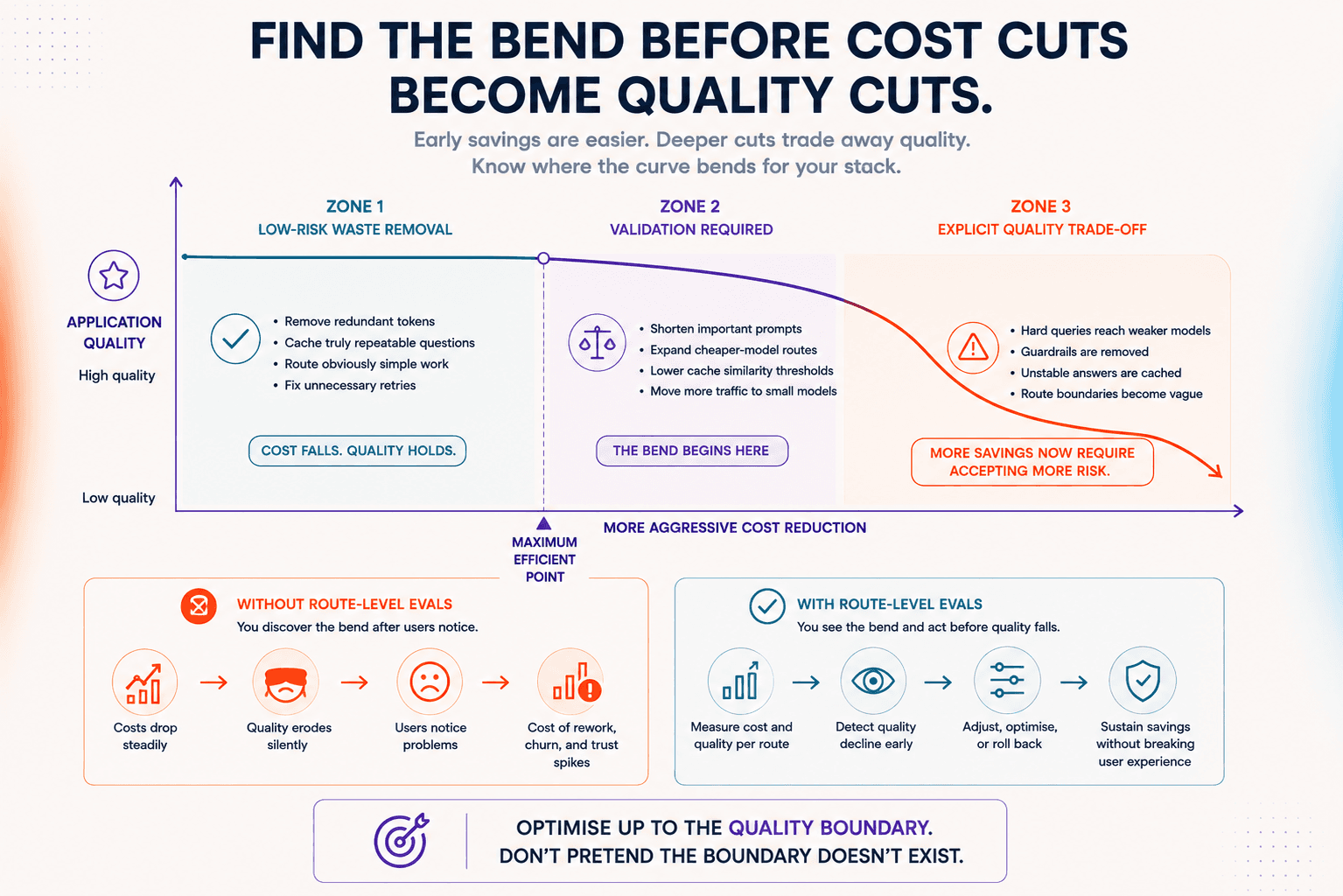
The first savings are usually safer than the last
Early LLM cost cuts are usually safe.
Deeper cuts almost always trade away quality, so you need to know where that bend in the curve is for your stack.
Early on, that curve is usually forgiving. You cut obviously redundant tokens, move clearly simple traffic to cheaper models, and cache genuinely repeatable questions.
Past that point, the trade shifts. Additional savings start coming from more aggressive moves:
Caching answers that aren’t truly stable
Routing harder queries onto cheaper models
Stripping instructions that were doing real work
Everything up to that bend is relatively low‑risk optimization.
Beyond it is a deliberate quality trade‑off that leaders should make with full visibility rather than assuming the curve stays flat forever.
Orq.ai connects routing decisions to quality evaluations
Most cost tools show you where money goes, not what it does to answers. That’s why teams ship regressions. They see spend fall, but they don’t see quality move.
Orq.ai puts routing and evaluation in the same control layer. The router sends easy traffic to cheaper models and hard traffic to stronger ones, while evals run per route to show whether each change still clears your quality bar.
Cost attribution uses the same slices. You can line up spend and quality for the exact workloads you care about.
Optimize for the cheapest route that still earns its place
If you’re about to pull LLM cost levers, put the evaluation loop in place first.
Treat every routing rule and small‑model route as an experiment.
Only keep the versions that stay within your quality bar on real traffic.
Then act on that visibility. Make cost decisions with spend and quality side by side, move more workloads onto cheaper paths where the metrics hold, and roll back any change that bends the curve too far.
Want that wiring without building it from scratch? Try running your stack through Orq.ai and see how routing plus evals change the way you cut the bill.