





OpenRouter and Requesty solve the same first-order problem: giving applications one OpenAI-compatible endpoint for multiple models while moving provider-specific integration work behind a gateway.
The harder decision appears after that initial setup.
A gateway that works well during experimentation can become restrictive once teams need consistent routing policies or reliable fallback across production workloads.
Those requirements expose meaningful differences between platforms that otherwise look similar at API level.
This comparison looks at model coverage, pricing and BYOK, routing behavior, developer workflow, observability, and governance.
OpenRouter vs Requesty: quick verdict
Choose OpenRouter when model breadth, provider choice, and flexible experimentation are the priorities.
Choose Requesty when you need dashboard-managed routing, EU data residency, and governance controls available earlier.
Consider Orq.ai when routing also needs to connect with evaluations, prompt management, and observability.
OpenRouter vs Requesty at a glance
Dimension | OpenRouter | Requesty |
Platform | Self-serve unified API and model marketplace | Managed LLM gateway with built-in operational controls |
Catalog | 400+ models across 70+ providers | 589+ models across 20+ providers |
Pricing | Provider inference prices with a 5.5% fee on credit purchases | 5% markup on managed model usage. Free and Enterprise plans available |
Routing | Price- and uptime-aware load balancing by default with controls for latency | Dashboard-managed fallbacks, load balancing, latency routing and caching |
BYOK | Supported, with a monthly fee-free allowance before a 5% fee applies | Supported on pay-as-you-go and Enterprise plans |
EU data residency | Available to Enterprise customers through EU in-region routing | Included across plans through a dedicated EU gateway |
Service commitment | Contractual SLA available on Enterprise | 99.99% advertised uptime. Custom SLA available on Enterprise |
Best fit | Teams prioritizing model breadth, provider choice, and experimentation | Teams prioritizing managed controls, EU residency and built-in analytics |
OpenRouter and Requesty in brief
Both platforms replace separate model integrations with one OpenAI-compatible API.
Although, keep in mind both are designed around different priorities.
What is OpenRouter?
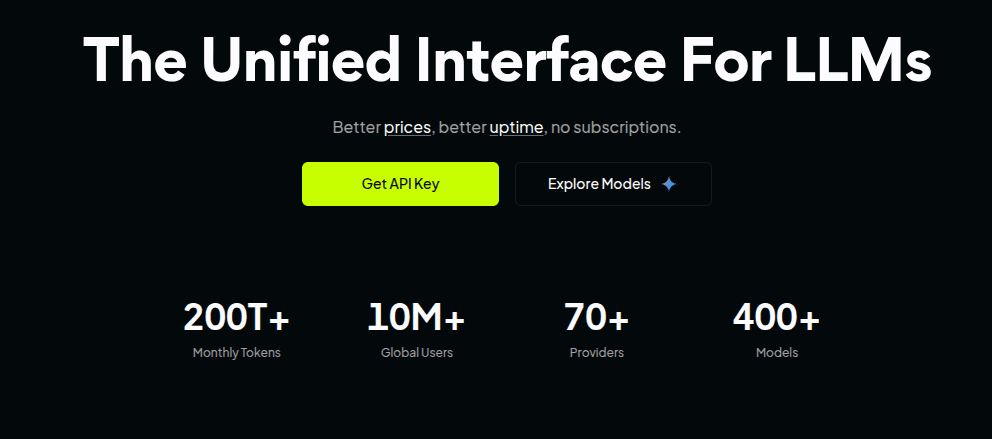
OpenRouter is a unified inference API and model marketplace.
Applications call one OpenAI-compatible endpoint instead of integrating separately with each model provider. Meanwhile, OpenRouter handles provider selection behind the gateway.
Its main distinction is access breadth.
You can test models across a large provider ecosystem and change provider preferences without rebuilding every integration.
What Is Requesty?
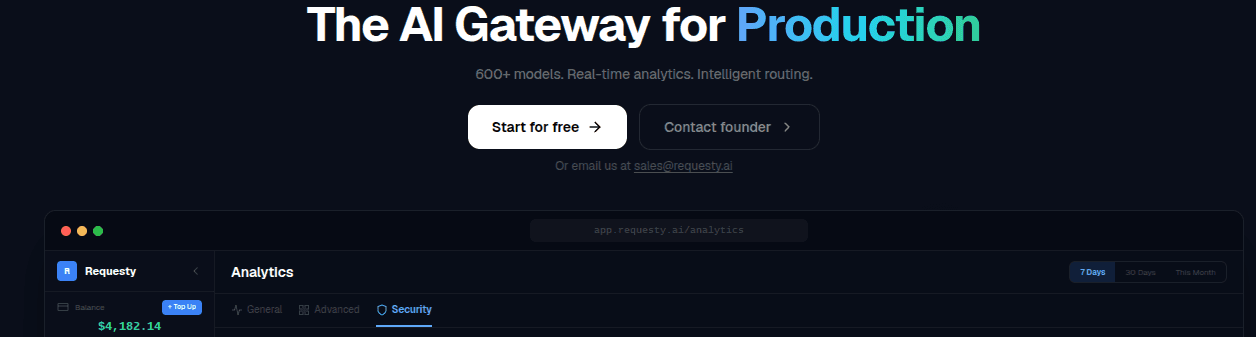
Requesty is a managed LLM gateway that also exposes models through one OpenAI-compatible endpoint.
The practical difference is emphasis.
OpenRouter is built primarily around a broad model and provider access.
Requesty focuses more on managing how LLM traffic is routed, monitored, and controlled in production.
Model and provider coverage
Model counts show how much choice a gateway exposes.
Provider coverage shows how much flexibility teams have over where those models run. This becomes more important when availability or pricing change.
OpenRouter
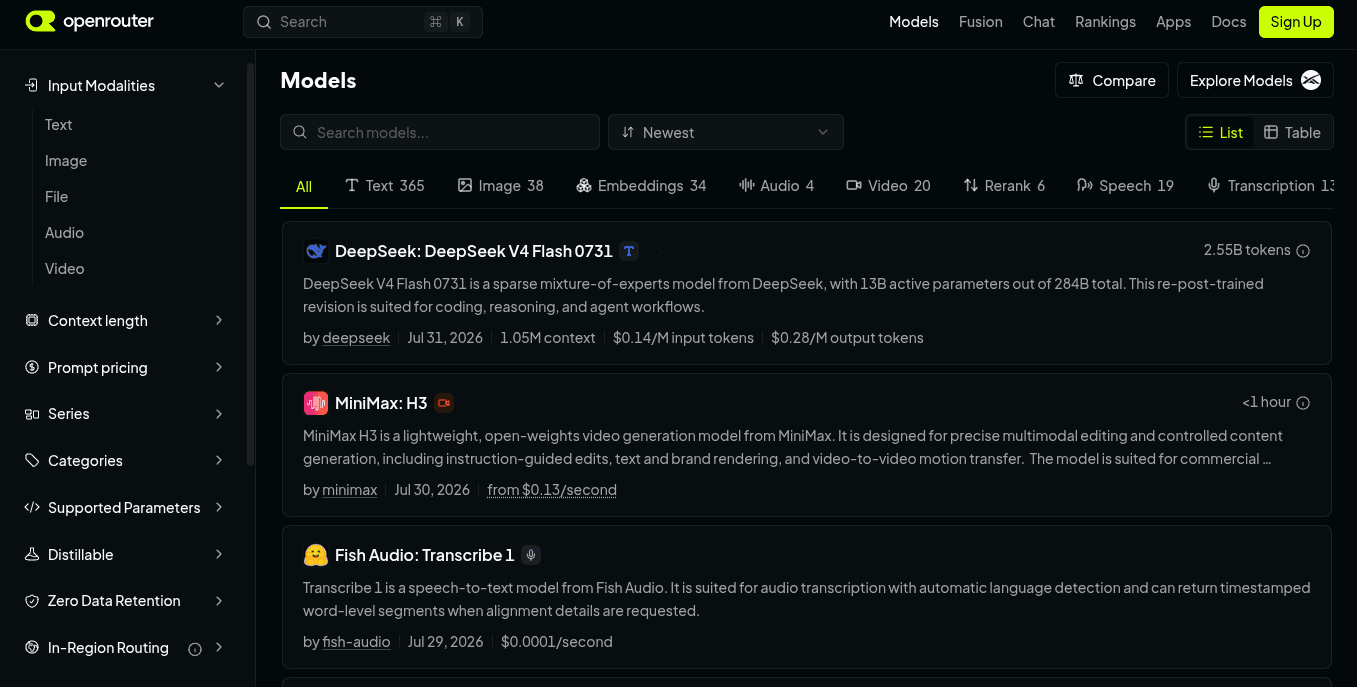
OpenRouter offers more than 400 models across over 70 providers. Its larger provider network gives teams more hosting options, including multiple endpoints for widely available open models.
Models use a consistent author/model identifier, while provider preferences can be controlled separately.
Requesty

Requesty’s model page currently advertises 589+ models across more than 20 providers and a 5% markup on managed usage. The full catalogue is available on its pay-as-you-go plan, while its free tier supports a smaller selection at up to 200 requests per day.
What the difference means
OpenRouter offers greater choice between providers. Requesty offers a larger model catalogue within a more concentrated provider ecosystem.
The deciding factor is whether the models you need are available through endpoints that meet your deployment constraints and provide enough redundancy for production traffic.
Pricing and BYOK
The headline token rate doesn’t show the full cost of a gateway. You also need to account for platform fees and how BYOK traffic is billed.
OpenRouter
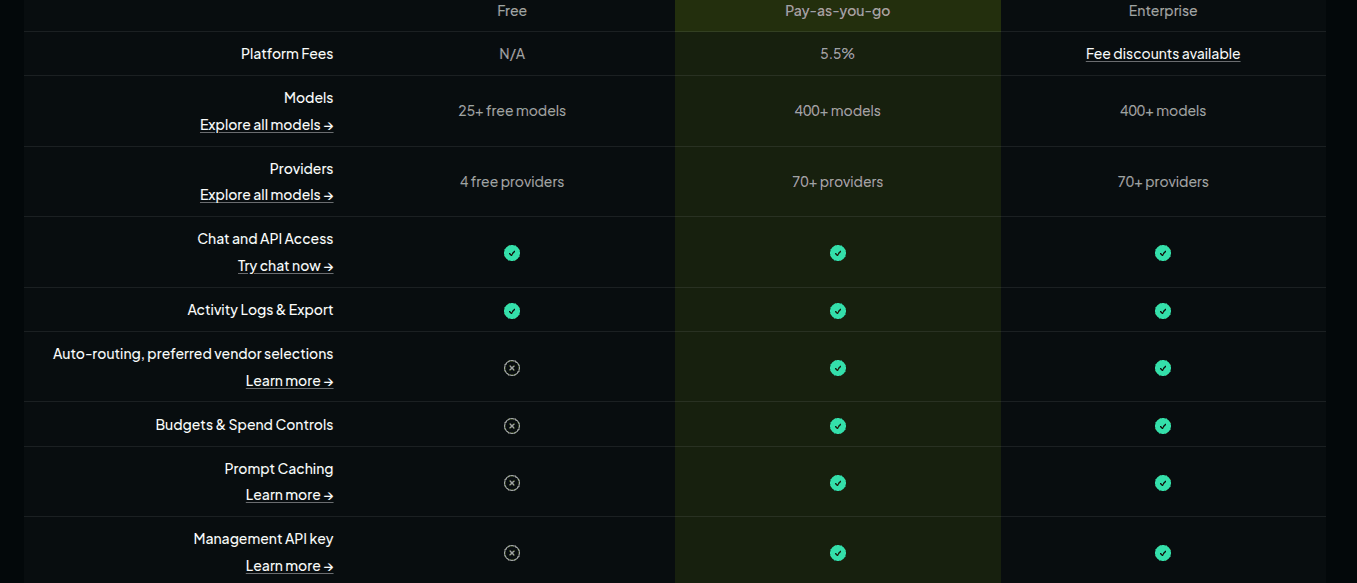
OpenRouter passes through provider inference prices without adding a token markup. Instead, it charges 5.5% when credits are purchased, with a minimum fee of $0.80. The free plan provides access to free models at lower request limits, while Enterprise offers invoicing and discounted platform fees.
BYOK lets teams route requests through their existing provider accounts. OpenRouter’s pay-as-you-go plan currently includes up to $25,000 of list-price BYOK inference each month without an additional fee. Usage above that allowance incurs a 5% charge.
Requesty
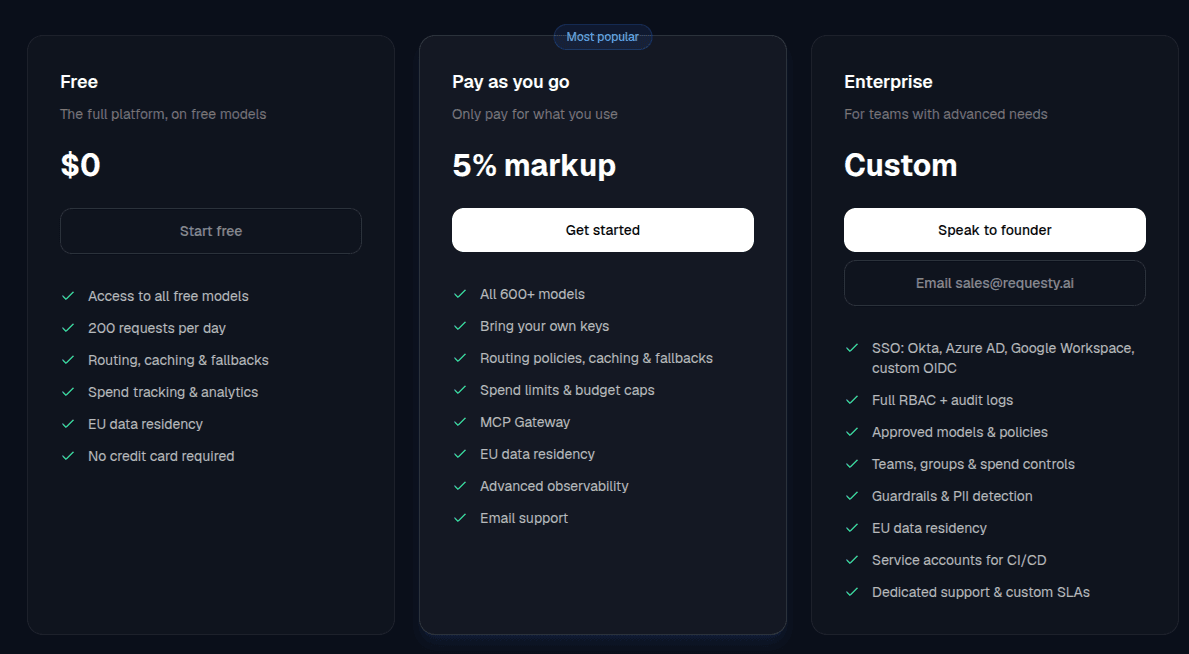
Requesty charges a 5% markup on managed model usage, with no subscription, seat fee, or minimum spend on pay-as-you-go.
Its free tier supports free models at up to 200 requests per day, while Enterprise pricing is customized.
BYOK is included on the pay-as-you-go plan. You’re able to retain your provider accounts and negotiated pricing while using those keys within Requesty’s routing policies.
Which pricing model is better?
Neither pricing model is automatically cheaper. OpenRouter charges when teams buy credits, while Requesty applies its fee to managed model usage.
OpenRouter’s BYOK allowance may be attractive below one million monthly requests, but the calculation changes once the 5% fee applies.
The reliable comparison is a replay of your own workload. Use representative prompts and response lengths. Then, include gateway fees and the direct provider rates attached to any BYOK contracts.
Routing, load balancing, and failover
Routing determines what happens when a provider slows down, reaches a rate limit, or becomes unavailable.
The main difference is where that control lives and how policies are applied.
OpenRouter
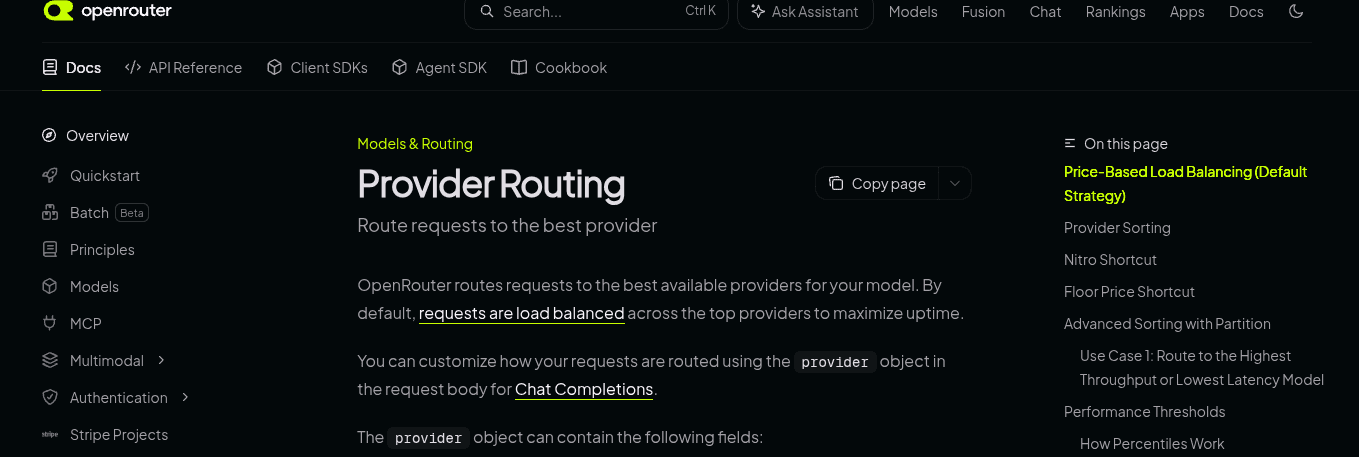
OpenRouter load balances across providers that host the selected model. Its default strategy filters out providers with recent outages, favors lower-cost healthy endpoints, and keeps the remaining options available for failover.
Provider failover stays on the same model where possible. Teams can also supply an ordered list of fallback models.
That way, OpenRouter can move to another model after rate limits or other request errors.
Requesty
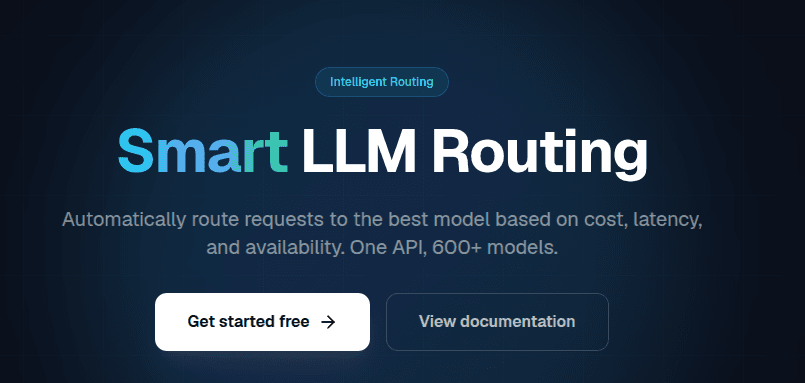
Requesty places routing logic inside reusable policies configured through its dashboard. A policy can define an ordered fallback chain, split traffic by percentage, or select the option with the lowest recent latency. The application calls the policy by name rather than hardcoding each model and provider.
Fallback policies can include retry limits and different credentials for each step. Changes take effect on Requesty’s side, so you can replace a model or adjust the sequence without redeploying the application.
Which offers more routing control?
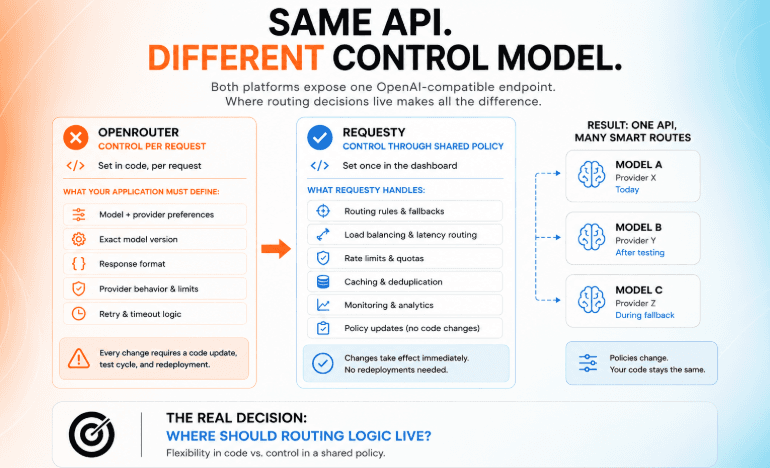
OpenRouter gives developers more granular control over provider selection within each request. Requesty makes routing policies easier to manage centrally across applications and teams.
OpenRouter is the stronger fit when engineers want to tune provider behavior directly.
Requesty is better suited to teams that want shared fallback and rollout policies managed outside application code.
Developer experience and migration effort
Both gateways work with OpenAI-compatible clients, so the initial integration is usually small.
The more important question is how much provider-specific logic remains in the application after the endpoint changes.
OpenRouter developer experience
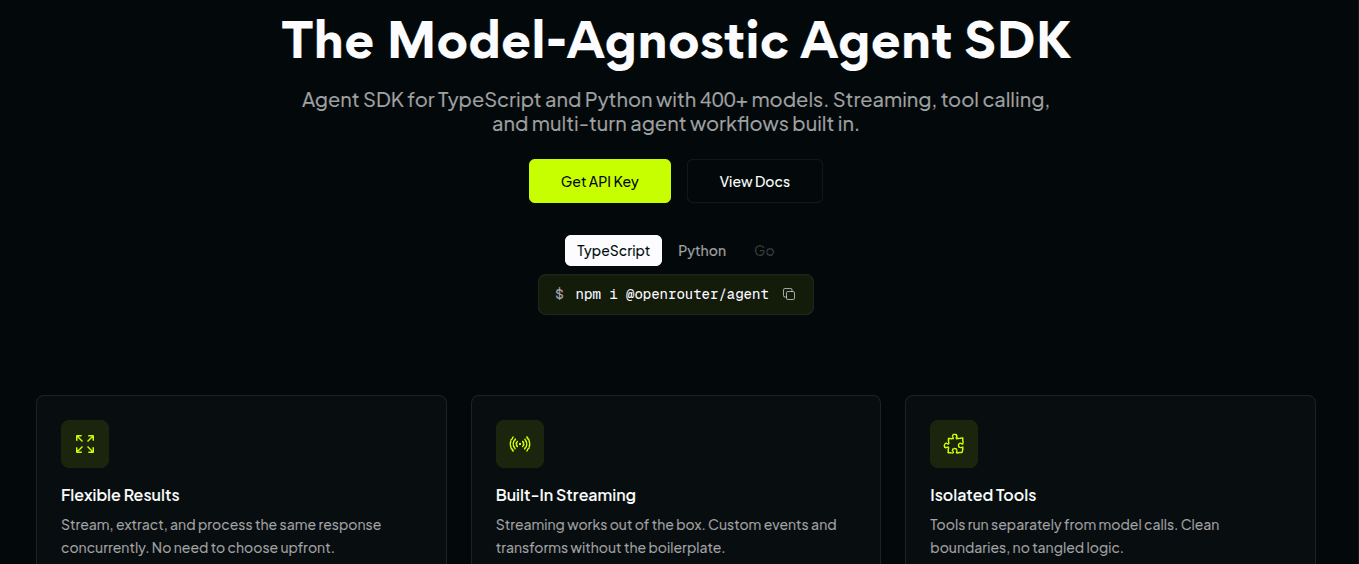
Existing OpenAI SDK clients can connect to OpenRouter by replacing the base URL and API key. Teams can also call the API directly or use OpenRouter’s TypeScript SDK when they want native types and tooling.
Model and provider choices can be supplied with each request. This suits developers who want routing decisions to remain close to application logic.
Requesty developer experience
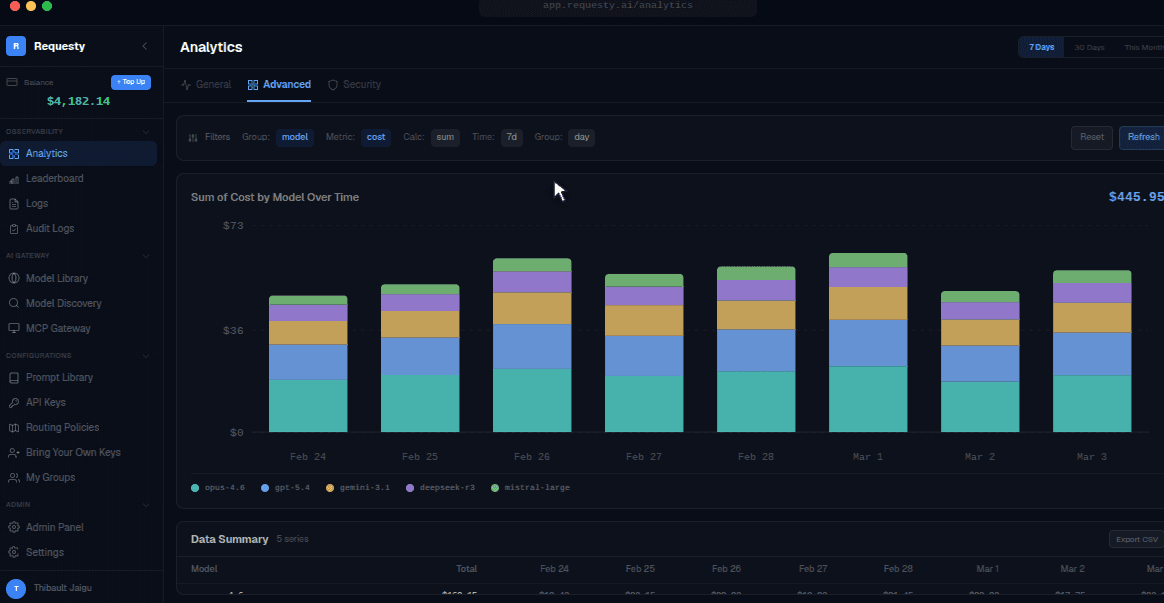
Requesty uses the same migration pattern: point an OpenAI client at its router and replace the API key. Applications can call a model directly or reference a routing policy created in the dashboard.
Because the policy acts as the model identifier, teams can change its fallback sequence without updating every calling service.
Which is easier to integrate and operate?
Initial setup is comparable. OpenRouter gives developers more direct control over model and provider selection, while Requesty makes shared routing policies easier to change outside application code.
The larger migration risk isn’t the number of lines changed. Teams still need to test prompts, structured outputs and error handling against every model they plan to use.
Observability, caching, and cost control
A gateway should show where spend comes from and how routing decisions affect performance.
Otherwise, teams can lower token prices while missing expensive retries or ineffective caching.
OpenRouter observability and cost visibility
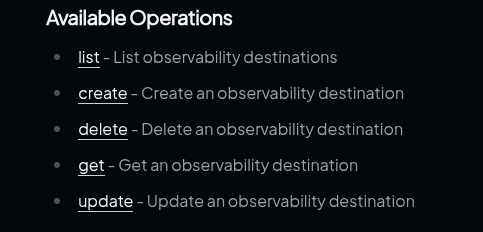
OpenRouter tracks request metadata like token usage and cost.
Prompt and response logging is optional, letting you retain basic usage visibility without storing application content by default.
Its cost controls are closely tied to model and provider selection.
You can steer traffic toward lower-cost endpoints, but you’ll still need application-level monitoring to determine whether the cheaper route maintains acceptable output quality.
Requesty observability and semantic caching

Requesty exposes costs and latency through its dashboard, alongside cache-hit and failover data. This makes it easier to see whether routing policies are reducing spend or simply shifting it elsewhere.
Semantic caching can reuse responses for sufficiently similar requests instead of calling a model again. You have the option to place cost limits inside routing policies, keeping controls separate from application code.
What production teams should compare
Requesty provides more built-in visibility into gateway behavior, particularly around caching and failover.
OpenRouter offers clear usage and cost data but places more responsibility on teams to connect gateway metrics with application outcomes.
Before choosing either platform, test whether it can attribute spend to the workloads your team actually owns.
A useful dashboard should reveal why costs changed, not just report the final total.
Governance, security, and EU data residency
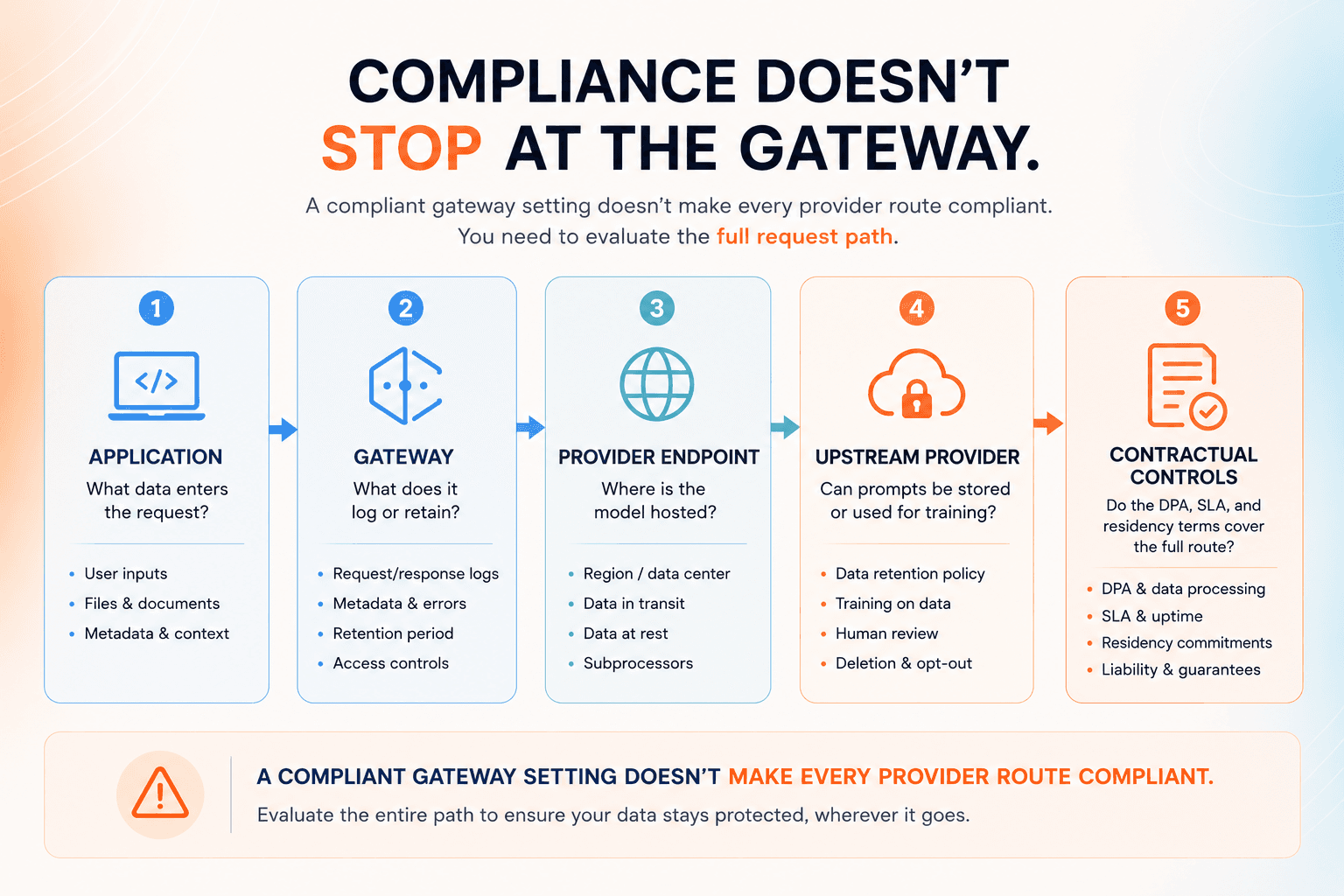
Governance depends on the full request path, not only the gateway. Start by identifying where prompts are processed and what each upstream provider retains. Then check which policies the gateway can enforce.
OpenRouter governance and data controls
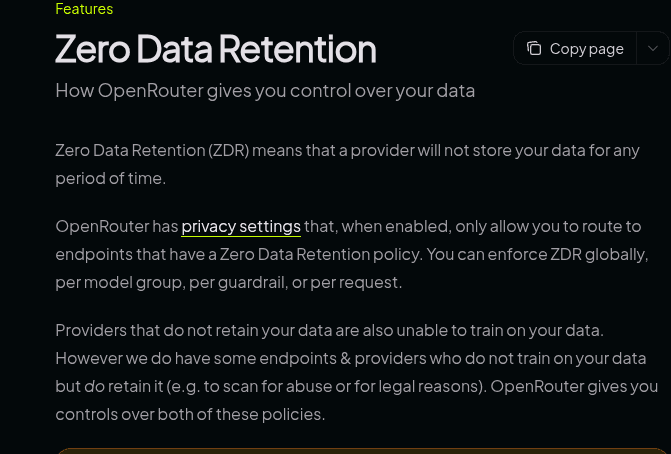
OpenRouter doesn't store prompt or response content unless logging is enabled. It retains request metadata for reporting, while its Zero Data Retention setting can restrict traffic to provider endpoints that do not retain the underlying data.
EU in-region routing is available to Enterprise customers by request. OpenRouter’s Enterprise plan also includes SSO/SAML and contractual SLAs.
Requesty governance and data controls
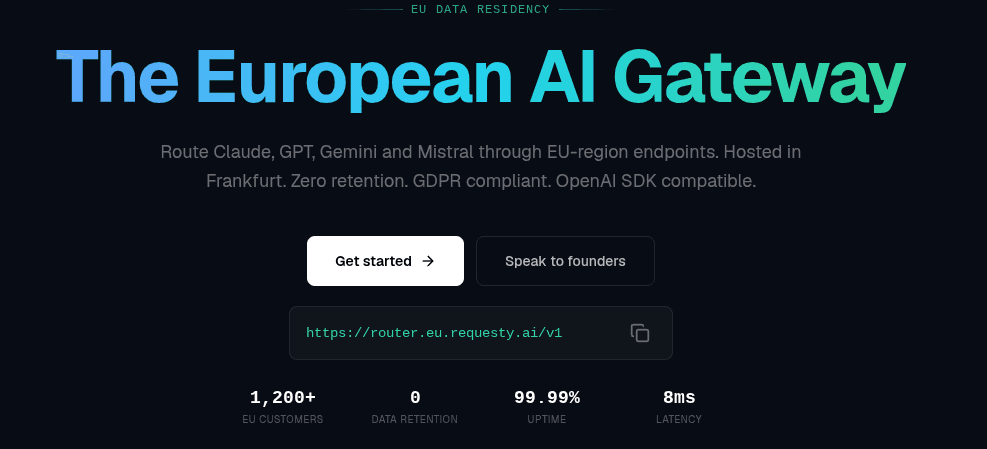
Requesty’s privacy policy says logging can be disabled entirely. When logging is enabled, prompts and outputs may be stored encrypted in the EU for up to 30 days. Its dedicated EU gateway is separately advertised as supporting zero-retention processing.
Requesty reports SOC 2 Type II compliance and provides a GDPR Data Processing Agreement on request. SSO, full RBAC, and PII controls sit within its Enterprise offering.
Which is better suited to regulated teams?
Requesty has the clearer advantage when EU data residency must be available before an Enterprise contract.
OpenRouter provides granular controls over provider retention policies, but its fully in-region EU route requires an Enterprise plan.
It’s important to understand that neither gateway makes a workload compliant by itself.
You’ll still need to verify the selected model endpoint and confirm that contractual terms cover the complete request path.
Choose OpenRouter when…
Choose OpenRouter when model and provider choice is the main priority. It suits teams that want to test a wide range of endpoints, control provider selection at request level, or keep routing decisions close to application code.
It’s also a strong fit when pass-through inference pricing and the BYOK allowance work well for your traffic.
The trade-off is that some governance and SLA requirements may push you toward Enterprise.
Choose Requesty when…
Choose Requesty when routing policies need to be managed centrally rather than embedded across services. It is better suited to teams that want built-in caching, gateway analytics, and EU data residency available earlier.
Requesty also makes sense when engineering, security, and platform teams need shared control over production traffic. The trade-off is a smaller provider ecosystem and a 5% markup on managed model usage.
When to consider Orq.ai instead
Orq.ai becomes relevant when routing is only one part of the operating problem.
Its router can run as a standalone gateway or connect to the wider platform when you need tighter links between model traffic and application quality.
When gateway functionality is only one part of the stack

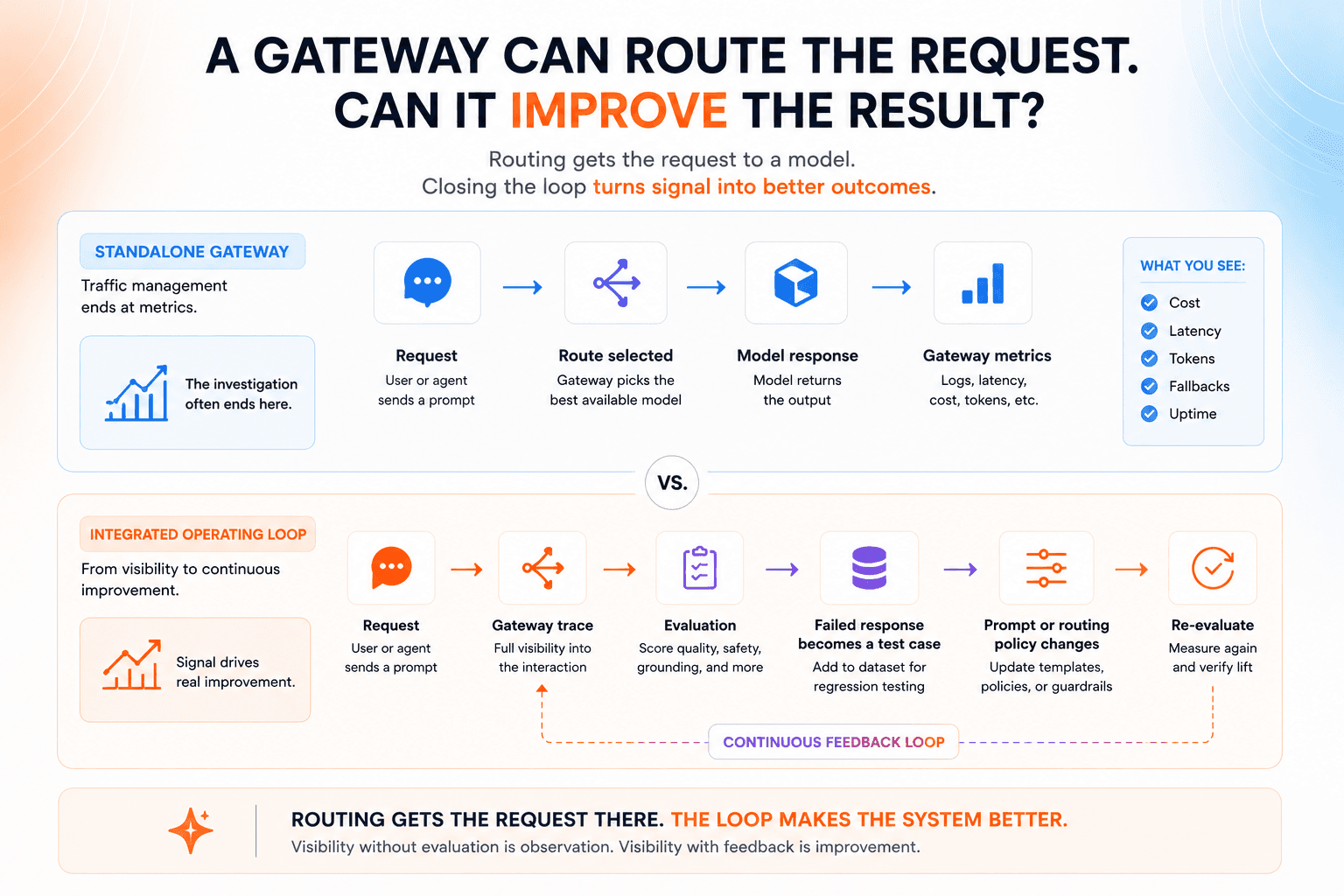
A gateway can show where a request went. On its own, it can’t tell you whether the fallback response was still accurate or whether a cheaper route damaged the user experience.
Orq.ai connects gateway traces with evaluations, making it possible to inspect a weak response and turn that failure into a test case. The same workflow can inform a prompt update or a routing change without moving the investigation between separate tools.
When broader governance and deployment options are required

Orq.ai supports managed cloud deployment as well as installation inside an enterprise VPC or on-premises environment.
You can also choose regional data handling which includes EU-based processing, rather than sending every workload through the same hosted gateway path.
That distinction matters when security teams need network isolation or control over where sensitive inference traffic runs.
Role-based access and data-masking controls extend those policies beyond model selection to the wider application workflow.
When OpenRouter or Requesty remains the better fit
OpenRouter remains a strong choice for teams that prioritize a broad provider ecosystem and want to control routing behavior directly through the API.
Requesty remains attractive when the goal is a focused managed gateway with central routing policies, and EU residency included before an Enterprise contract.
Choose Orq.ai when routing decisions need to feed a broader process for testing and improving the application.
Choose one of the narrower gateways when model access and traffic management are the full requirement.
OpenRouter vs Requesty: Final Verdict
OpenRouter is the stronger choice when breadth and flexibility come first. Its larger provider ecosystem gives you more room to test models, tune provider selection, and keep routing decisions close to the application.
Requesty fits teams that want more of the operational work handled inside the gateway. Central policies along with earlier access to EU residency make it easier to standardize production traffic across teams.
The wrong choice is the one that leaves a known requirement like governance for a migration six months later.
When those needs already extend beyond gateway infrastructure, Orq.ai becomes the more complete option.
Compare Orq.ai against your current gateway requirements and see whether a broader operating layer makes sense for your AI stack.