






Teams end up with a complex multi-LLM stack one model at a time, adding a new provider for cost reasons, another for performance, another for compliance or locality.
That setup works at first, until the seams start to show in production. 88% of enterprises now use AI in at least one function, but only 7% have fully scaled it.
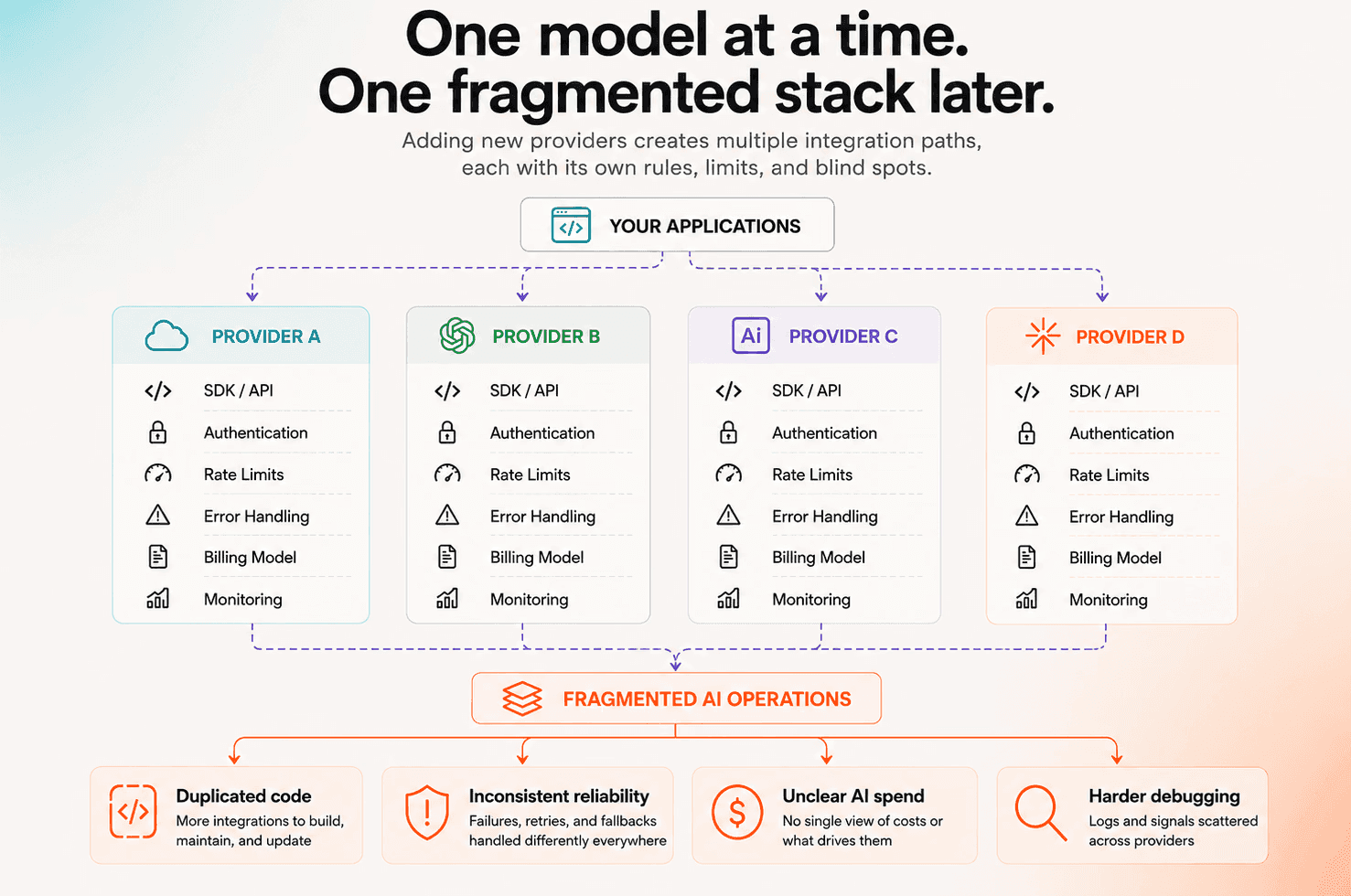
Each provider has a slightly different API, auth flow, and billing model. Different teams wire them in different ways. Reliability varies by service. AI spend grows, but no one has a single view of where it comes from or which workloads drive it.
The easiest way to switch providers is to keep provider-specific logic out of application code from the start
In this guide, we’ll walk through where multi-LLM setups typically break down and how to bring existing LLM integrations under one layer without disrupting production.
Why managing multiple LLM APIs becomes a problem
As more providers enter the stack, the system gets harder to coordinate.
Every new provider introduces its own way of doing things and those differences spread through the system.
Once multiple teams start shipping features on top of different providers, the small differences like auth flows and limits start to compound into real operational drag.
More than 30% of the increase in API demand will come from AI and tools using LLMs by 2026.
Every provider adds another integration to maintain
LLM APIs look interchangeable, but each one behaves slightly differently.
Authentication, request formats, and error codes all vary across providers.
Adding a model means writing another integration, chasing edge cases, and keeping that code up to date as APIs change.
When these paths live inside application code, changing or swapping models stops being a configuration change and turns into a coordinated engineering project.
AI costs become harder to explain
LLM spend is rising quickly. Meanwhile, provider bills rarely explain what’s driving it.
As multiple teams adopt different models, it becomes difficult to attribute costs to specific workflows or customers. More expensive models often become the default, and cost increases are only identified after they scale.
For example, a routine classification workload can drift onto a frontier model if routing is left ungoverned.
Reliability depends on more than provider uptime
Most failures are partial, not complete outages.
Requests hit rate limits, time out, or slow down in particular regions. Teams respond by adding retries and fallbacks, yet they do it in different ways in different services. On a diagram, the system has redundancy.
We’ve found that adding a second provider is the easy part. Resilience only becomes real when fallback behaviour is defined and visible for each workload.
In production, reliability and behavior depend on which integration a request happens to pass through.
Troubleshooting becomes a reconstruction exercise
Understanding a failed request often requires piecing together data from logs and multiple provider dashboards.
Model selection, retries, and fallback behavior are rarely visible in one place. Provider updates can simultaneously change model behavior without obvious signals, introducing subtle regressions.
What a unified LLM platform does
A unified LLM platform (AI gateway or router) introduces a control layer between your applications and model providers.
Instead of every service integrating with providers directly, applications send requests through a single system that handles routing and visibility. The shift is subtle at the API level, yet significant on an enterprise level.
Model decisions move out of application code and into a layer that can be managed centrally.
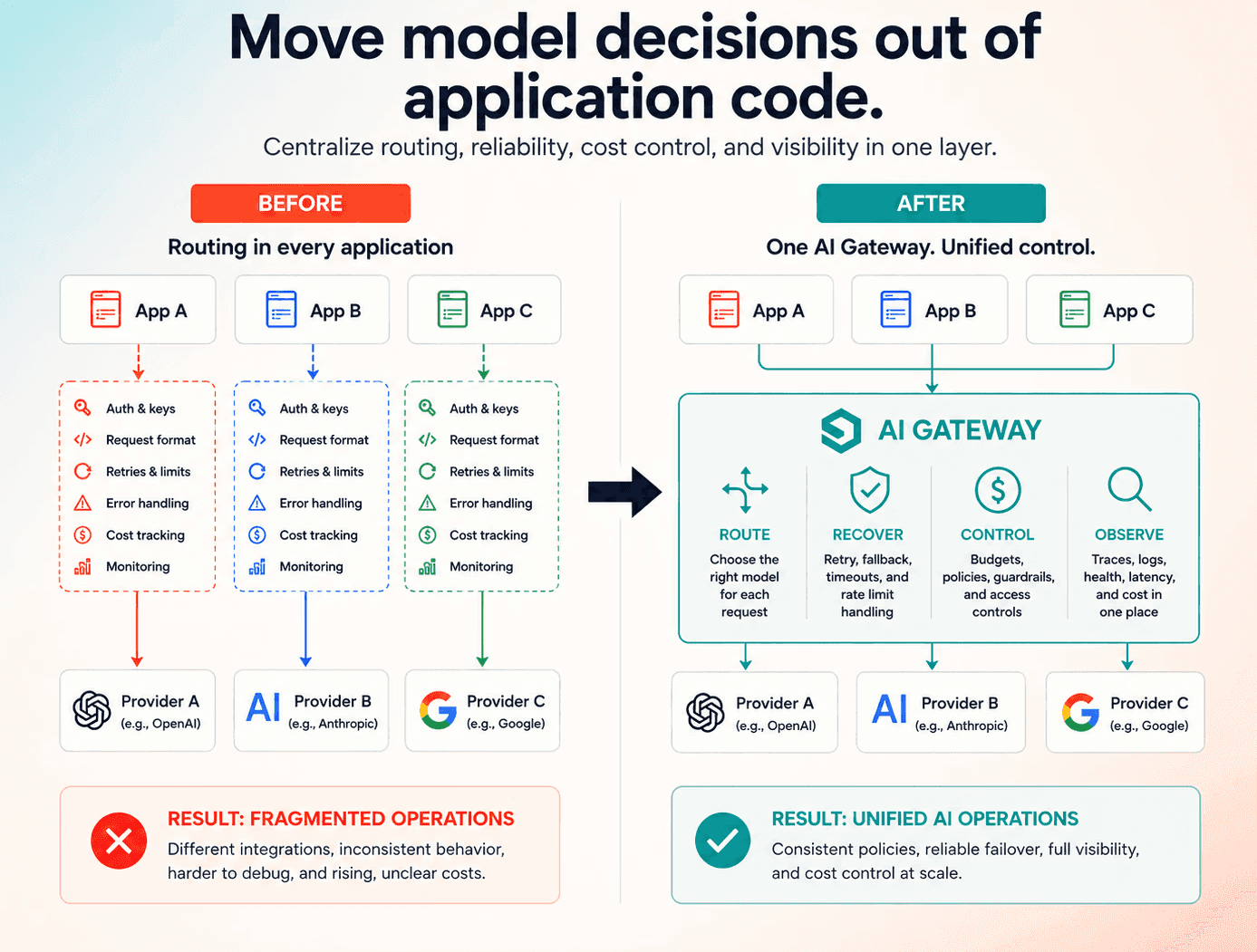
Some of its core capabilities are:
Keep applications running when providers fail
Extra models only help if you can actually move traffic between them when things break.
A gateway gives you one place to handle timeouts, rate limits, and regional failures.
Redundancy becomes real instead of theoretical.
Fallbacks still need deliberate design. Switching models can change output quality, or latency, so failover policies have to match the workload. What's acceptable for a background summarization job might be acceptable for a user-facing assistant.
Control which models handle which requests
Different workloads have different constraints, despite those decisions often ending up hardcoded across services.
A shared routing layer allows teams to define policies centrally: which models are allowed for certain data, when to prioritize cost over quality, or how to handle latency-sensitive requests.
More advanced setups introduce dynamic routing.
Our view is that routing should never optimize cost or latency in isolation. A cheaper model is only cheaper if it still meets the quality threshold for the task.
But without clear guardrails, this can trade quality for cost in ways that are difficult to detect.
The same request should get the same treatment no matter which service sends it.
See where AI spend comes from
Provider invoices show totals, not drivers.
Once traffic flows through a single layer, usage can be attributed to specific applications, workflows, or customers. This is where cost control becomes actionable.
Teams can identify which use cases are driving spend, set limits, and prevent high-cost models from becoming the default for routine tasks.
Without that visibility, cost work usually happens after the fact, once patterns are already locked into production.
Trace model traffic across providers
Debugging multi-LLM systems requires more than logs.
A gateway creates a consistent record of each request:
Which model handled it
How long it took
How many tokens were used
Whether retries or fallbacks occurred.
That reduces the need to piece together data across multiple provider dashboards.
How to consolidate multiple LLM APIs into one platform
Consolidation is less about swapping APIs. It’s more about pulling control out of application code into a shared layer that can be managed deliberately.
Most teams go through four steps.
The strongest migrations we see rarely move every workload at once. Teams usually start with one high-volume path and expand once the new layer has proved itself under real traffic.
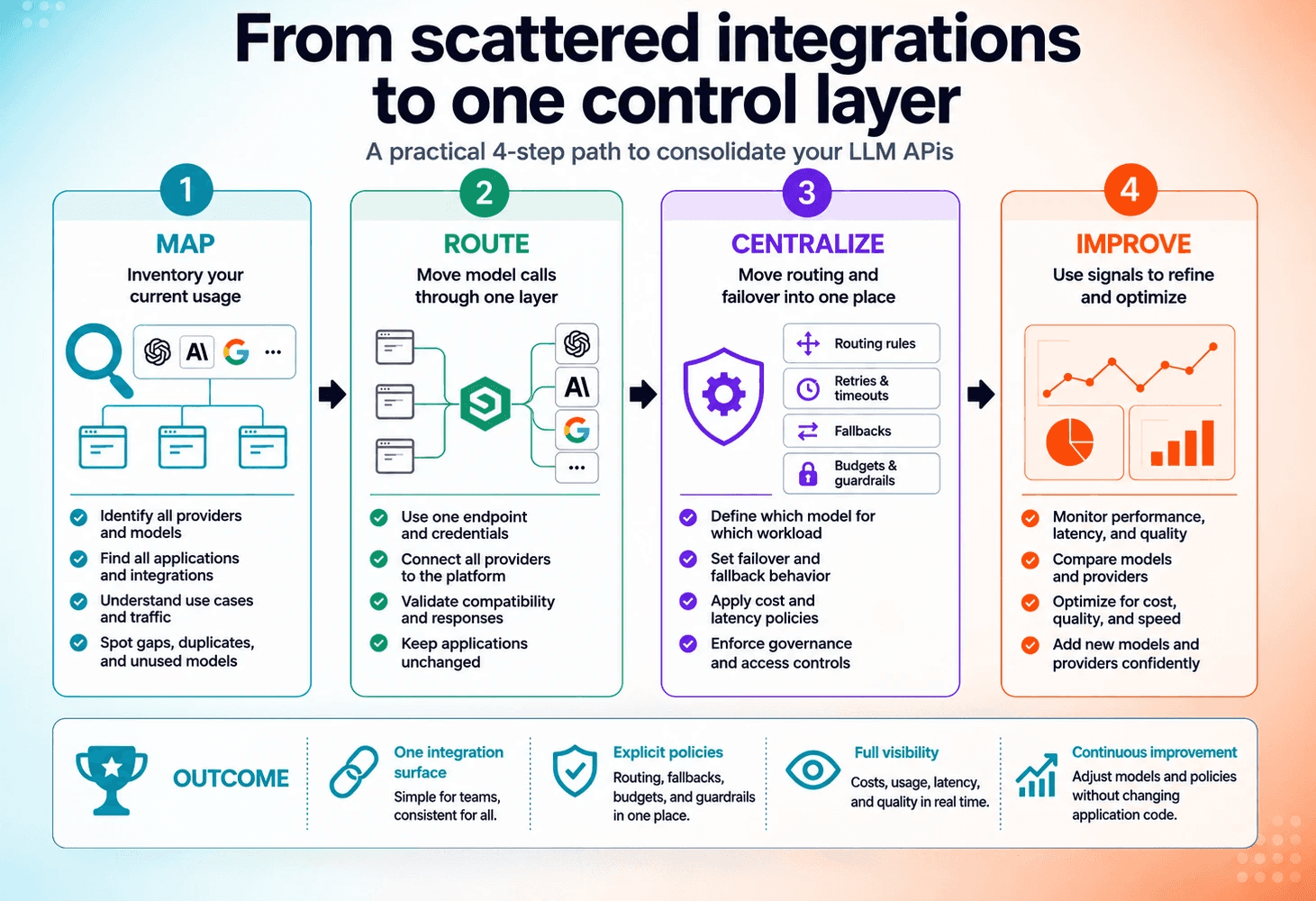
1: Map your current usage
Before changing anything, you need a clear picture of what already exists.
Which providers are in use, which applications call them, and what those requests are doing. This is usually where gaps show up. Think unused models, duplicate integrations, or traffic paths no one has written down.
Skipping this step means you only connect the parts you can see and leave hidden integrations running on their own.
2: Route all traffic through one layer
The target is straightforward: every model call goes through the platform.
For OpenAI-compatible setups, this is often a minimal change by updating the endpoint and credentials.
3: Move routing and failover into one place
Once traffic flows through one layer, you can define how models are actually used.
Which workloads use which models, when to prioritize cost vs quality, and what happens when a provider fails. In most systems, these decisions already exist. They’re just scattered across services and implemented inconsistently.
Consolidation turns those implicit rules into explicit, enforceable policies.
4: Operate and improve continuously
The first migration is only the start.
With routing in one place, you can adjust decisions as models and workloads change.
This is where teams begin experimenting with new models and fixing inefficient defaults without touching application code.
Common pitfalls when consolidating LLM APIs
Most migrations look simple on paper.
The problems tend to show up a few weeks later, once real traffic is running through the new layer.
Leaving old retry and fallback logic in place
This is one of the most common (and hardest) to spot problems.
Teams migrate to a gateway but leave existing retry logic inside their applications.
They’re left with app retries, gateway retries, and higher costs.
In some cases, requests bounce between providers longer than intended so failures are harder to diagnose.
Strong teams treat consolidation as a chance to remove this logic from application code, not duplicate it.
Hardcoding model choices
Hardcoded model names are convenient early on. Yet they become fragile as soon as you need to change anything.
These references spread across services, scripts, and prompt templates. Switching models then turns into a coordination exercise.
Mature setups keep model selection in configuration, not scattered constants across the codebase.
Treating fallbacks as an afterthought
Connecting multiple providers doesn't automatically give you resilience.
Fallbacks need to be defined deliberately. Which model replaces which, under what conditions, and with what constraints.
Without this, failover becomes unpredictable. A fallback might keep the system online but return outputs that break downstream logic or degrade the experience.
Most teams only see this clearly during their first real incident, when the system stays up but starts behaving differently in subtle ways.
Assuming the migration is the finish line
The first version of the setup almost never behaves exactly as expected under real load.
Cost patterns shift and certain workloads end up on the wrong models. Without good visibility, these issues stay hidden until they’ve become normal.
Teams that handle this well treat the first few weeks after migration as a tuning phase by watching traffic closely and adjusting routing decisions.
Choosing the right path forward
Most teams can build a simple gateway. The harder question is whether they want to keep owning it as the system grows more complex.
Multi-LLM setups don’t sit still.
Models change, prices move, and routing rules need regular updates. A layer that starts life as a small abstraction quickly turns into ongoing infrastructure work. New providers, new workloads.
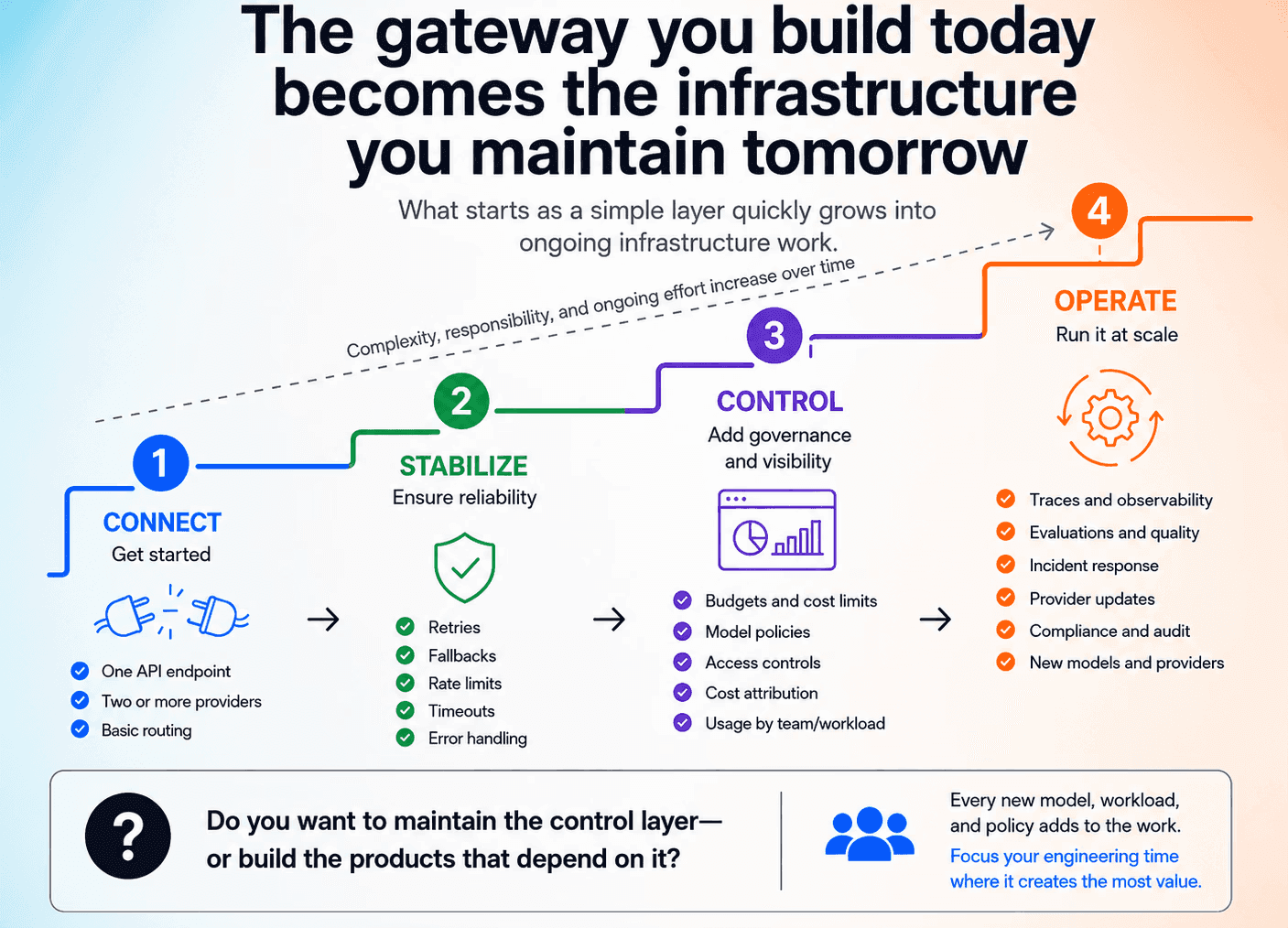
Spend engineering time maintaining that control layer yourself, or put that effort into the products and systems that rely on it.
If you’d rather focus on the latter, book a demo with Orq.ai to see how a unified AI gateway fits into your existing stack.