






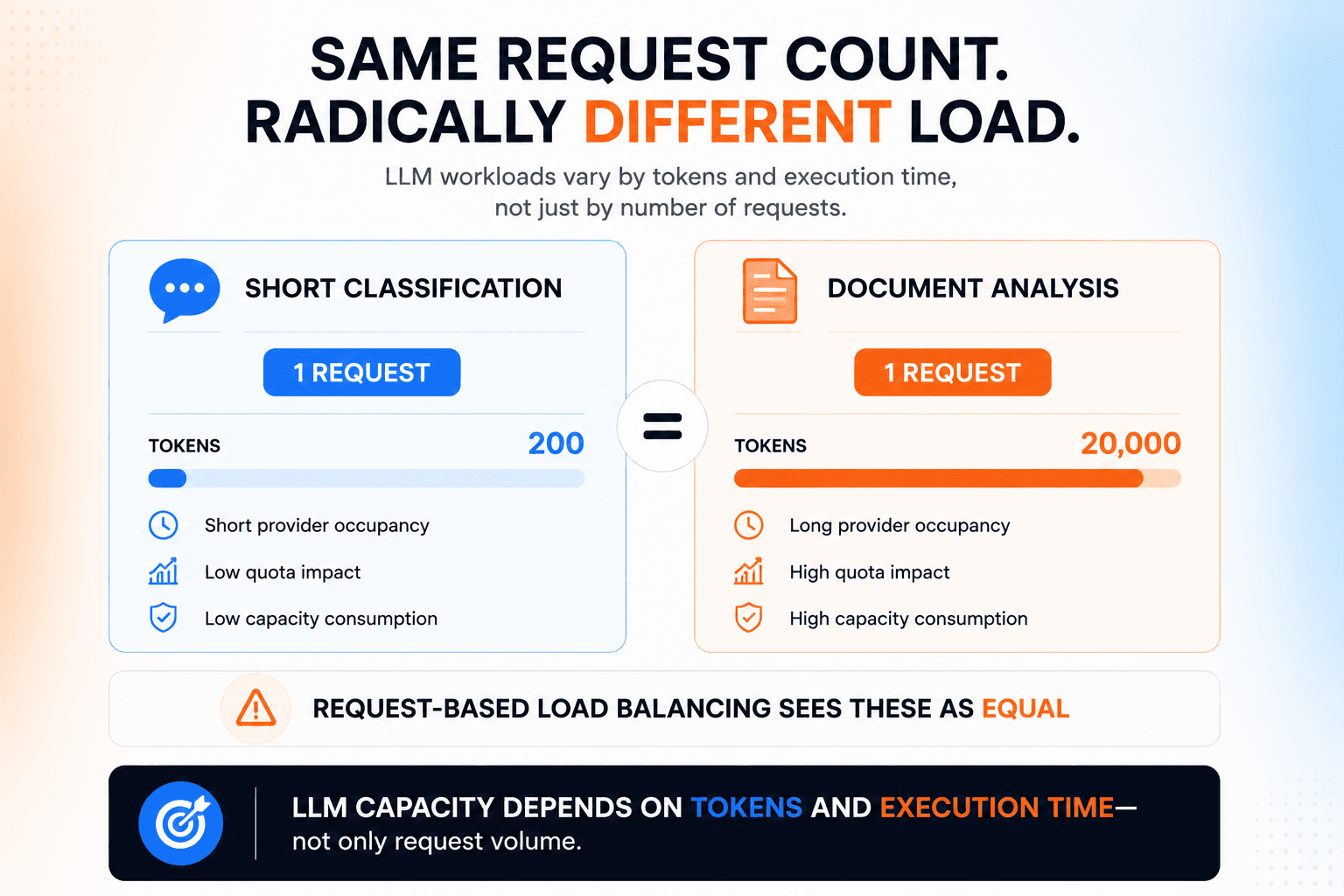
Production LLM traffic gets uneven as you scale. One request might be a cheap classification, another a 50‑page analysis, and both look identical in a request counter. The result is familiar to anyone who has pushed a system past the demo phase.
Sporadic 429s, tenants starving each other of capacity, and retries turning a small slowdown into a full traffic storm.
We see a lot of teams try to fix this with more instances and a few per‑endpoint rate limits.
That works for conventional APIs where each call is roughly similar. But it breaks for LLMs, where the real unit of work is tokens instead of requests. One workflow can drain a quota while everything else still appears healthy.
This guide explains how to design both without scattering quotas and routing logic across every application.
Why traditional load balancing breaks for LLM traffic
LLM traffic isn’t like ordinary backend traffic because the unit of work is unstable. One request can be lightweight, another can be extremely expensive.
Both may hit the same endpoint within seconds.
That gets harder once you add multiple models and different pricing tiers.
At that point, load balancing has to account for tokens and provider quotas at the same time.
Use token-aware limits alongside request caps
Rate limiting for LLMs should be based on tokens, not just requests. A user sending 100 short prompts and a user sending one long document analysis don’t consume the same amount of capacity, so request-based limits can let heavy usage drain resources while the counter still looks healthy.
We find that token-aware limiting works best through reservation and reconciliation. Estimate the likely token budget before dispatch, reserve that capacity, then return any unused allowance after generation.
That’s why you should measure tokens per minute or allocate compute budgets by user or tenant.
Protect critical workloads with hierarchical quotas
Token limits show how much capacity a workload consumes. They don’t decide which workloads should receive that capacity first.
A customer-facing support assistant and a background summarization job may call the same model. However, they shouldn’t compete on equal terms.
The assistant needs reserved headroom and predictable latency. The batch job can wait or use spare capacity.
Without that separation, one noisy tenant or low-priority workflow can exhaust the quota that critical traffic depends on.
We recommend allocating capacity by tenant and workload, then reserving headroom for customer-facing features. Background processing should usually be the first traffic delayed when demand exceeds supply.
Once quotas reflect workload priority, routing can decide where each eligible request should go.

Match each request to the right model and provider
Rate limiting decides whether a request can run.
Load balancing decides where it should run.
In practice, that means routing against a set of constraints rather than spreading traffic evenly. A low-cost model may suit a high-volume classification task. Yet, a reasoning-heavy workflow may need a stronger model even when it is slower or more expensive.
Provider health also changes in real time, so the preferred route can shift as latency rises or quotas tighten.
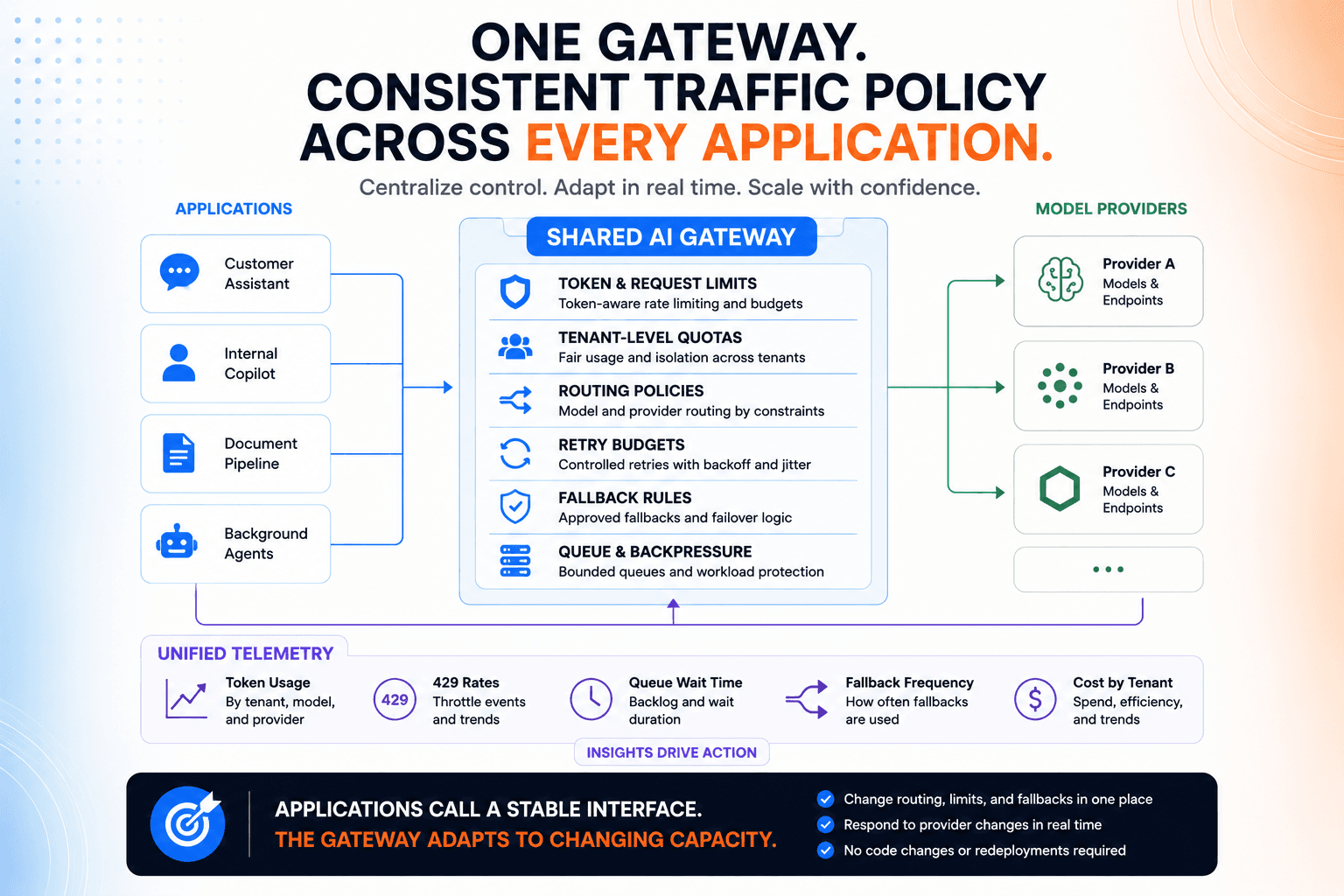
A useful policy applies those constraints in order. First exclude routes that cannot meet the task’s quality or compliance requirements. Then choose between the remaining options based on current capacity and cost. If the preferred endpoint becomes unavailable, move the request to an approved fallback rather than retrying blindly.
Control retries, queues, and backpressure
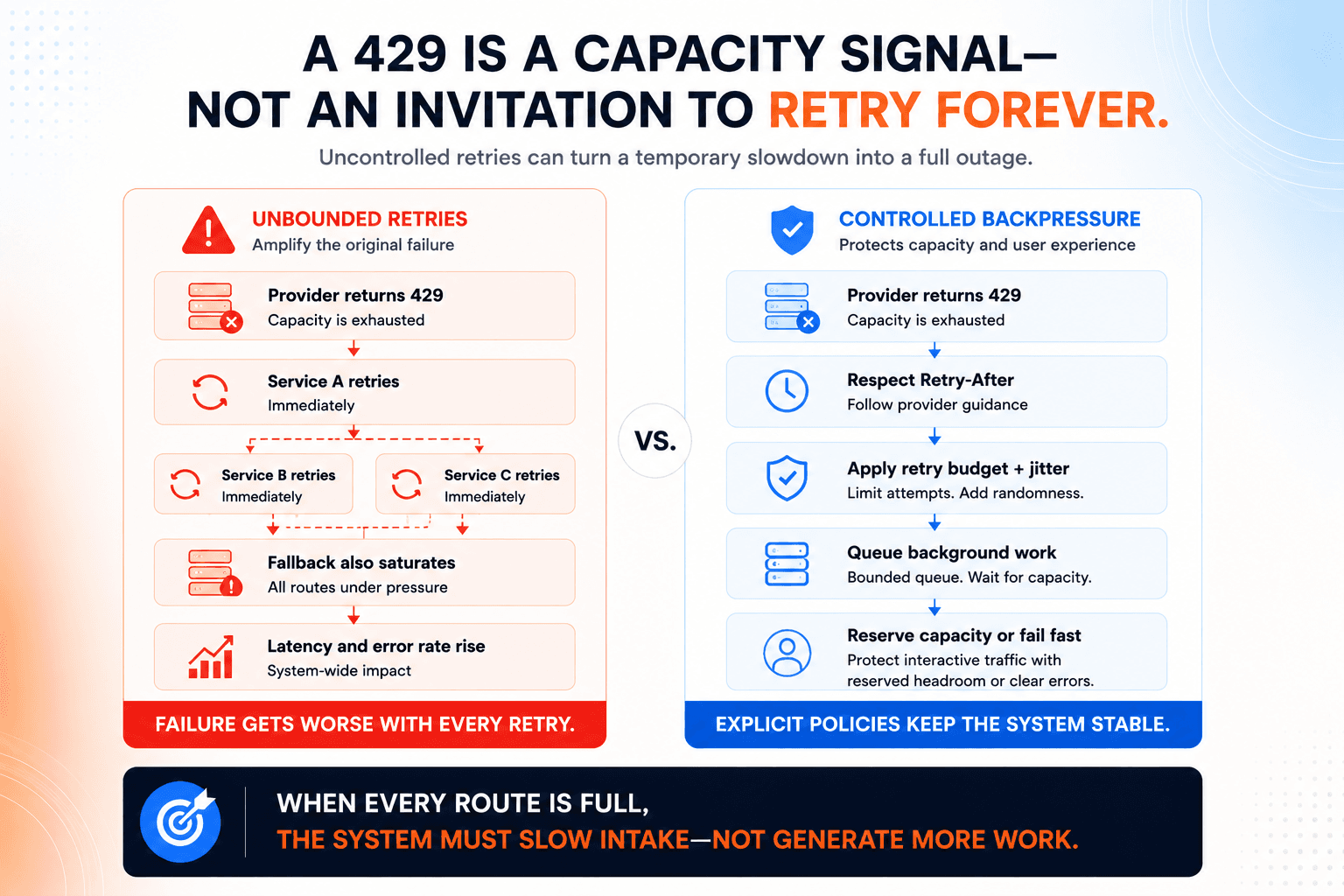
A rate-limited request shouldn’t trigger an open-ended retry loop. When several services retry at the same time, a temporary capacity problem can turn into a retry storm that increases latency across every route in the fallback chain.
Set a retry budget for each request and honor provider retry headers. Add jitter between attempts so traffic doesn’t return in synchronized bursts. Retries should also stop when the remaining latency budget is too small for another useful attempt.
Not every workload needs the same response. Background jobs can enter a bounded queue and wait for capacity. Customer-facing requests may need reserved headroom or a fast failure that the application can handle clearly.
The important decision is what happens when no eligible route has capacity. Without an explicit backpressure policy, the system keeps generating work faster than providers can serve it.
Centralize traffic policy in an LLM gateway
An LLM gateway places control between the application and model providers. Routing decisions, usage limits, and provider policies can then be applied consistently across services instead of being rebuilt inside each codebase.
Without that layer, implementations drift. One service retries too aggressively. Another ignores token limits. A third uses a different fallback sequence.
Centralizing policy reduces that inconsistency and lets you change traffic behavior without redeploying every application.
We treat routing rules like shared infrastructure.
Version them, test them on limited traffic, and keep a fast rollback path.
Monitor token pressure before providers start throttling
Traffic policies only work when teams can see capacity tightening before requests start failing. Track token utilization against each provider quota, and fallback frequency. Break those signals down by tenant or workload so one noisy path does not disappear inside account-level totals.
Fallback frequency can reveal deterioration before the final error rate changes. Requests might still succeed while more traffic moves onto slower or more expensive routes. That’s why we recommend monitoring the route taken, not only the final HTTP status.
The metrics also need context. A falling error rate may look positive while fallback traffic quietly raises latency or cost.
Similarly, stable request volume can hide a surge in token consumption from longer prompts or outputs.
Good monitoring should show why traffic moved, which quota triggered the change, and whether the fallback still met the workload’s requirements. Without that visibility, teams are reacting to throttling after it reaches users.
How Orq.ai handles load balancing and rate limiting
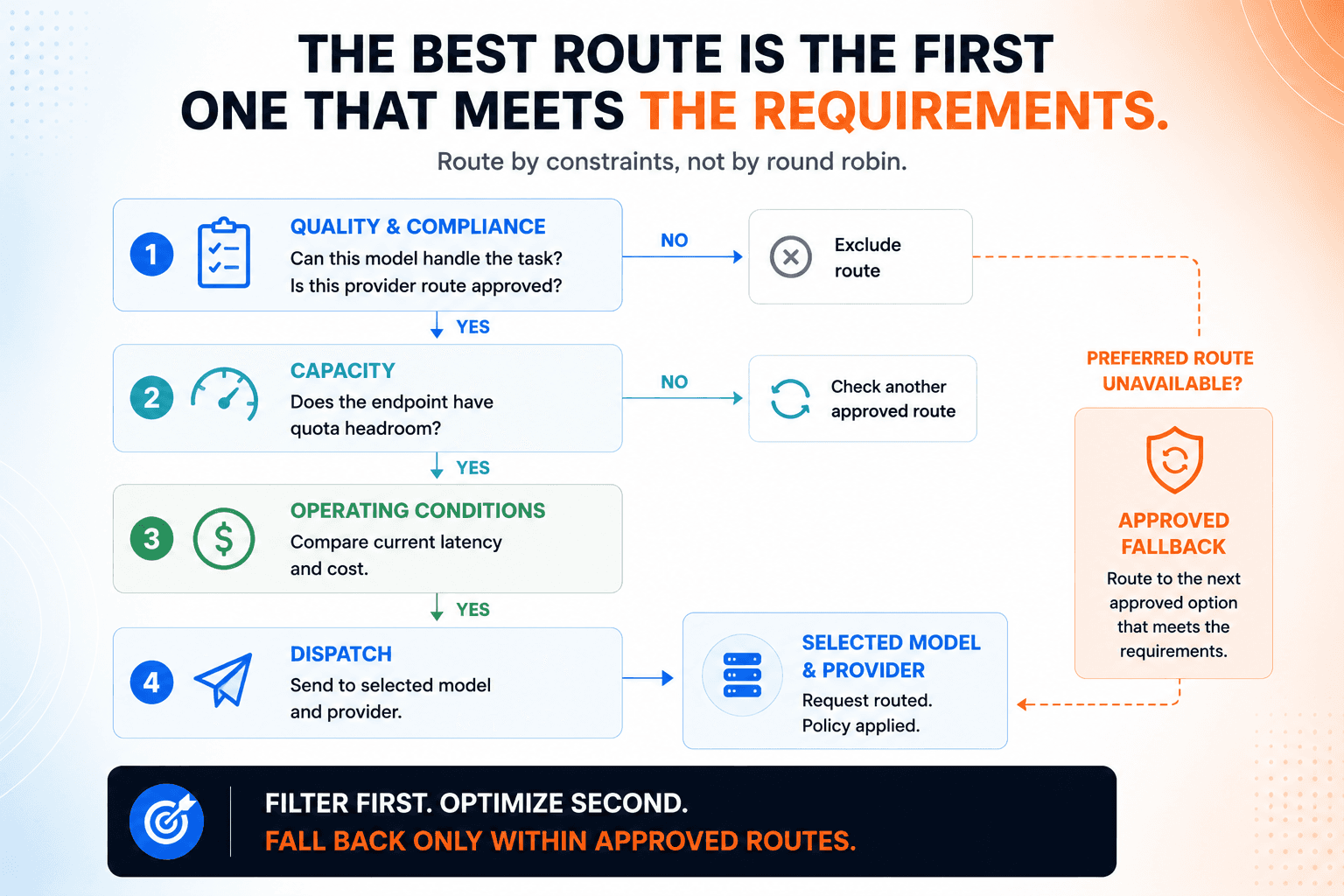
Orq.ai’s AI Gateway moves traffic policy out of individual applications and into a shared control layer.
Gateway telemetry then shows where capacity is being consumed and when policies are triggered. Engineers can inspect usage by tenant, model, or provider. After, they can adjust limits or routing without changing each application separately.
Application code stays focused on product behavior, while the gateway owns how requests consume capacity and respond to provider constraints.
Test routing changes against real traces before applying them broadly.
At Orq.ai, we look beyond successful delivery and compare output quality and cost per successful task.
Treat traffic policy as shared infrastructure
Provider quotas move and the way traffic hits your models changes faster than any one application can keep up. If each service owns its own limits and fallback logic, every adjustment turns into a mini migration.
You patch code and hope nothing breaks under real load. Treating traffic policy as shared infrastructure fixes that coordination problem.
Put token-based limits and backpressure in a gateway layer. Let applications keep calling a simple interface.
When capacity tightens or a provider starts throttling, you can shift tenants without asking every product team to rewrite their own protections.
If you want to see how that looks on real traffic instead of in theory, book a demo to explore how Orq.ai applies token-aware routing and rate limiting across production workloads.