





Choosing an AI aggregator looks simple at first.
Point the application at one API and replace a growing collection of provider integrations.
Then the workload expands.
One team wants to switch between frontier LLMs every week. Another needs OCR, speech, translation, and vision all inside the same workflow.
Routing rules start to matter, and that's where the wrong choice becomes expensive.
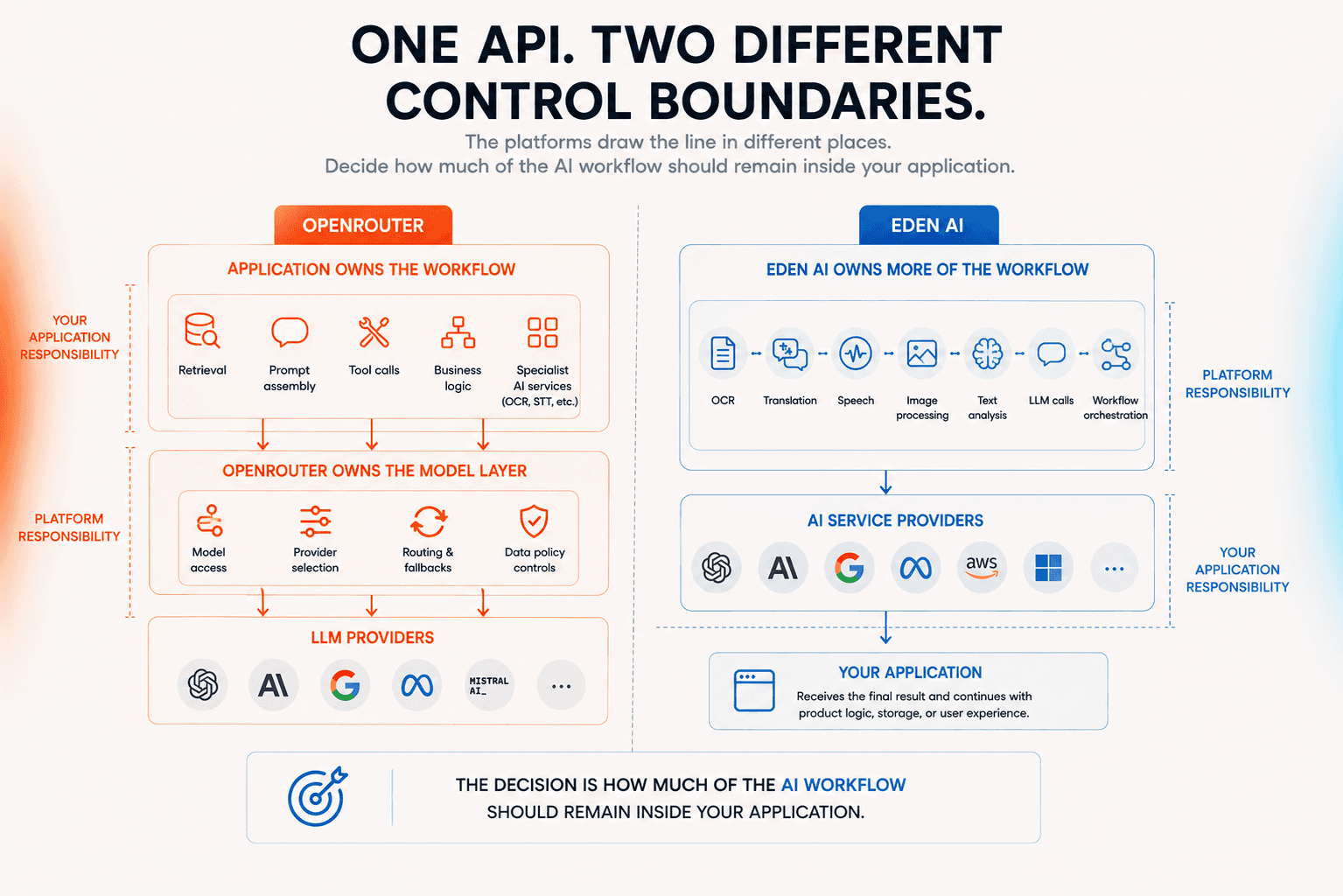
The decision comes down to the boundary you want the platform to own.
Eden AI vs OpenRouter at a glance
The practical difference is scope.
Here’s how the two platforms differ:
Dimension | OpenRouter | Eden AI |
Primary role | Managed model marketplace and routing layer | Unified AI gateway for LLMs and specialist AI services |
Coverage | 400+ models across 70+ providers | 500+ models across 50+ providers |
Workload scope | Text, image, audio, embeddings, and multimodal generative models | LLMs plus OCR, translation, audio, image processing, and text-analysis APIs |
API design | OpenAI-compatible API across its model catalog | OpenAI-compatible LLM endpoint plus a separate Universal AI schema for specialist services |
Routing control | Provider ordering, price or performance sorting, provider filters, fallback control, and data-policy constraints | Automatic model selection through |
Pricing | Provider pricing passed through, with a 5.5% fee on pay-as-you-go credit purchases | Provider pricing passed through, with a 5.5% platform fee at checkout |
Data controls | Provider-policy filtering, ZDR enforcement, optional logging, and EU in-region routing for enterprise customers | Dedicated EU endpoint with EU processing, zero data retention, GDPR documentation, SOC 2 |
Best fit | Developer-owned applications that need frequent model experimentation and detailed control over provider selection | Workflows that combine LLM calls with document, speech, or vision services |
Catalogue totals aren’t directly comparable because Eden AI counts models across a wider range of AI services, whereas OpenRouter concentrates on generative-model access.
OpenRouter goes deeper on LLMs, Eden AI goes broader across AI services
One API can hide two very different architectures.
OpenRouter is built for teams whose main problem is model choice.
It gives developers access to a large LLM catalog while leaving prompts and provider selection under application control.
Eden AI takes on a wider role.
Language models sit alongside OCR, speech, and other specialist services. Its orchestration layer can connect those steps without forcing teams to build every integration themselves.
That changes the buying decision.
OpenRouter gives developers a sharper way to work across LLMs. Eden AI reduces the plumbing required when a single workflow crosses several types of AI.
Choose OpenRouter when model access and routing control come first

OpenRouter works best when the application already owns the workflow and the main problem is choosing which model should handle each request.
It gives developers one API for that model layer without asking them to move the rest of the application into a separate orchestration platform.
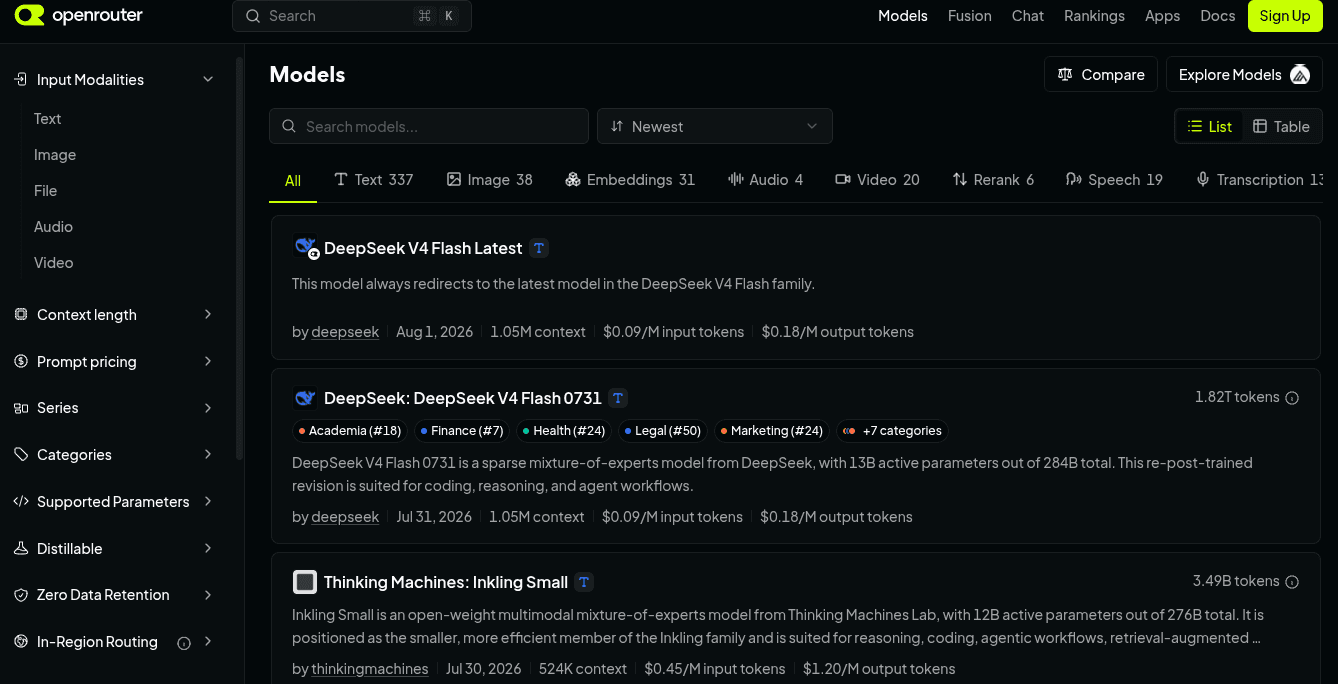
Its catalog is built around language models
OpenRouter’s strength is depth across generative models. Teams can test frontier releases and specialist models without opening a new provider account or rebuilding the integration each time.
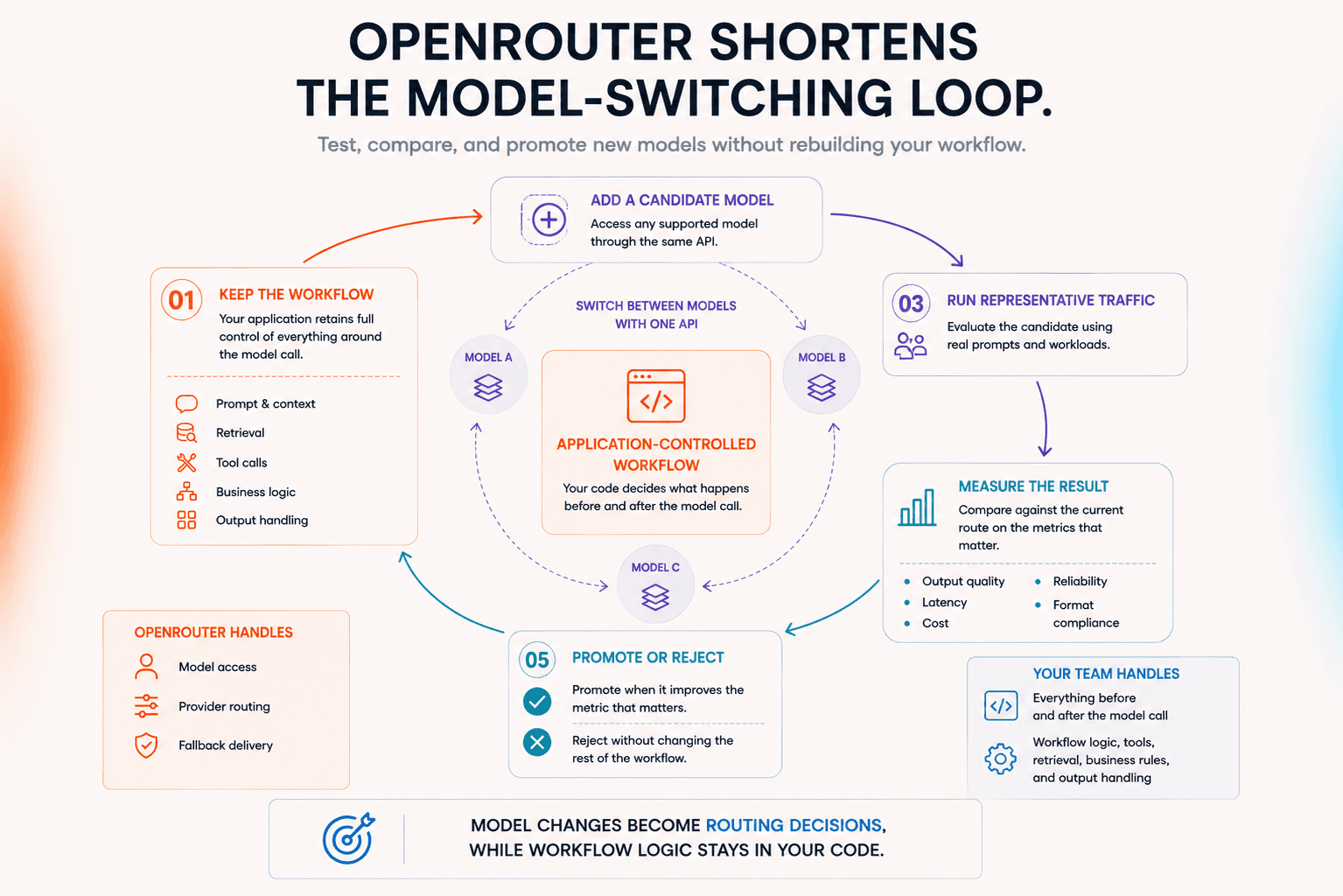
That makes model evaluation much faster.
A new release can be placed behind an existing prompt and compared against the current route.
It can be promoted only when it improves the metric that matters for that workload.
The focus is narrower than Eden AI’s. OpenRouter supports multimodal generative models, but specialist services such as OCR and document translation still sit elsewhere in the stack.
Developers keep workflow logic inside the application
OpenRouter handles model access and provider routing.
Your code still decides what happens before and after the request.
That boundary gives engineering teams more control. They can use the frameworks and infrastructure to manage:
Retries
Retrieval
Tool calls
Business logic
Prompt assembly
Debugging also stays close to the application rather than moving into a visual workflow layer.
The trade-off is ownership. OpenRouter handles the model call, while your team still builds and maintains the surrounding workflow.
Choose Eden AI when one workflow spans several AI services

Eden AI starts to make sense when the LLM is only one step in the job.
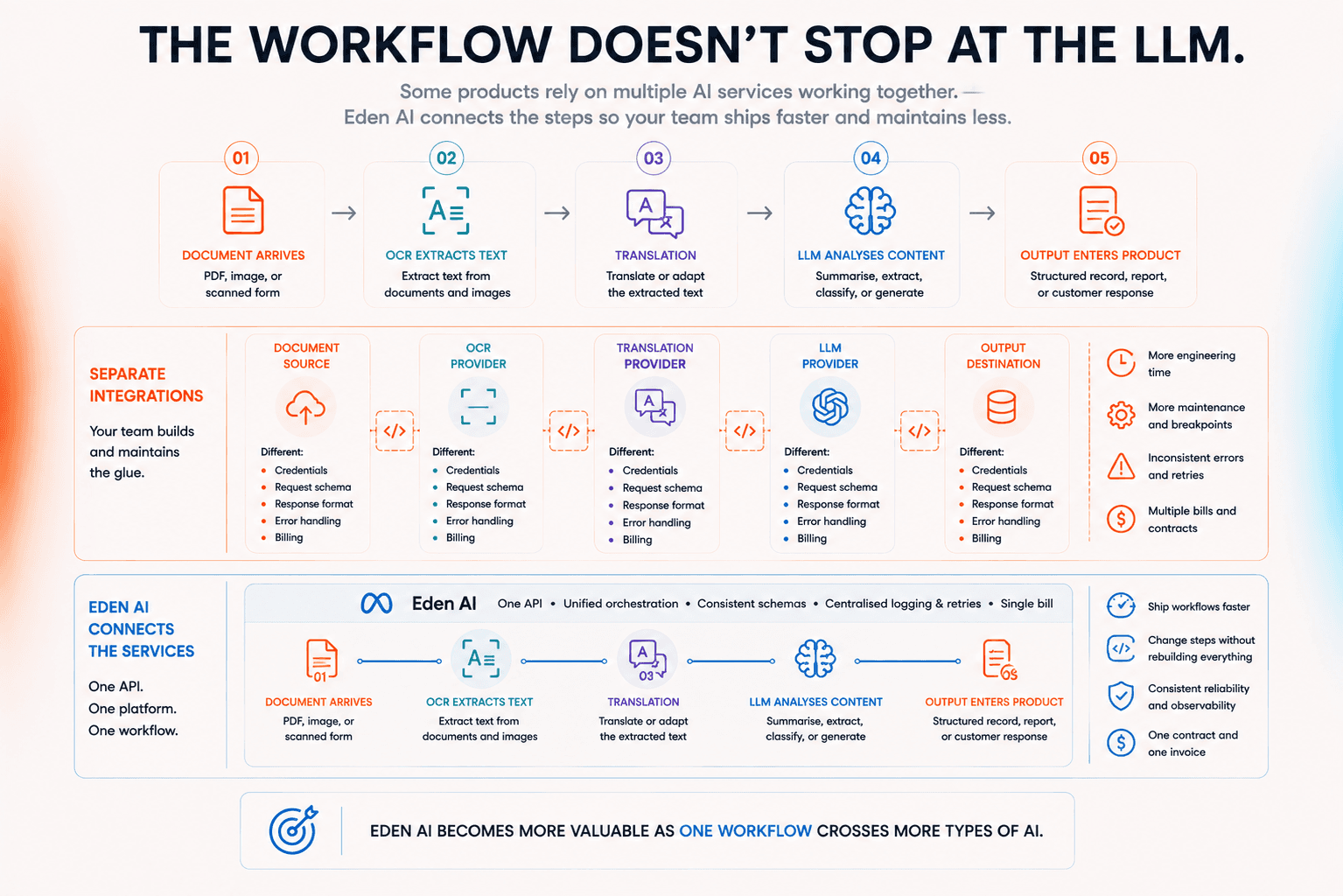
Imagine a document workflow that begins with OCR, passes the extracted text into translation, then sends the result to a language model.
With OpenRouter, your team still has to connect those services. Eden AI is designed to hold more of that sequence together.
One API covers language, document, speech, and vision tasks
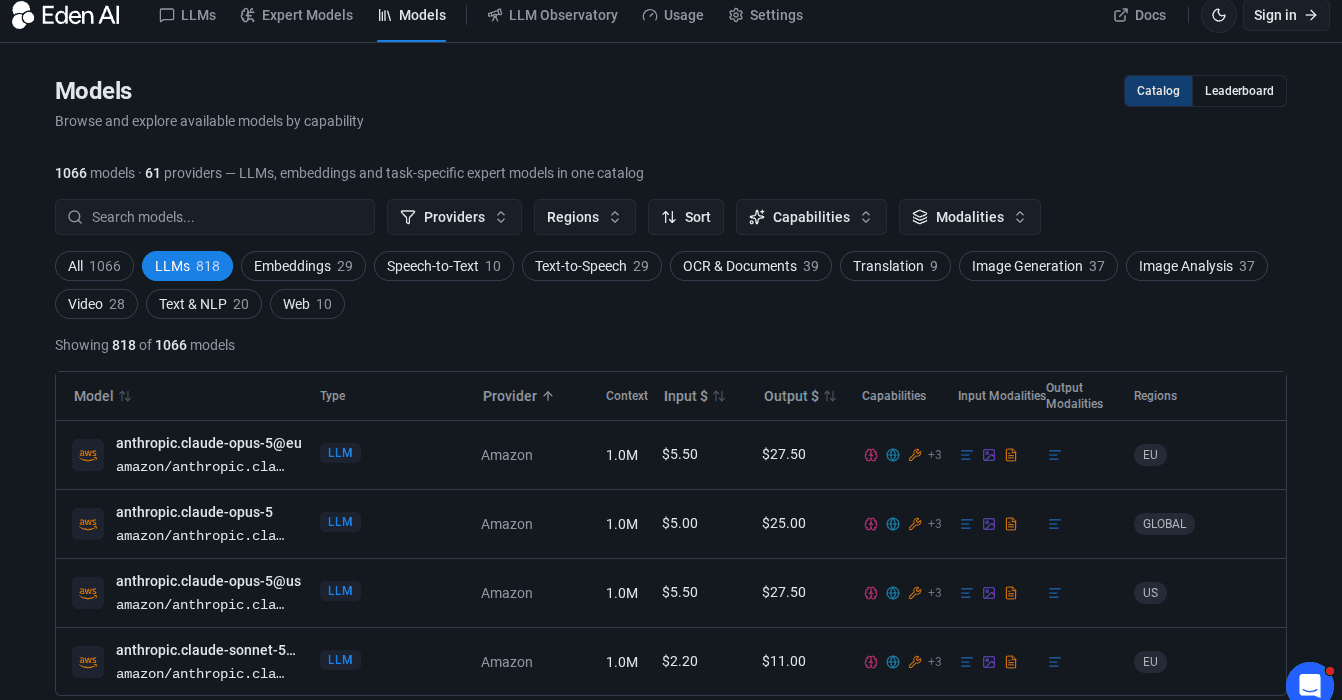
Eden AI gives teams access to language models alongside specialist services such as OCR and speech processing.
That wider scope matters when a product depends on several types of AI at once. Instead of maintaining separate provider accounts and response formats, you can manage the workflow through one platform.
The workflow builder reduces custom orchestration work
Eden AI’s visual builder lets teams connect steps without coding the entire pipeline from scratch.
A product manager could prototype a document workflow, hand it to engineering for review, and refine the sequence without waiting for every change to become a development ticket.
For internal tools and repeatable automations, that can remove a surprising amount of glue code.
Compare total operating cost, not only the platform fee
The platform fee is only one part of the decision.
A few percentage points matter once traffic scales, but they're easier to measure than the engineering work happening around them.
The bigger question is what your team has to build, maintain, and support after the model returns a response.
With OpenRouter, more of that work stays in your application. Teams gain flexibility, though they also own the orchestration, integrations, and operational complexity that come with it.
Eden AI shifts some of that responsibility into the platform. That can reduce development time when a workflow combines several AI services, even if the headline platform fee looks similar.
Compare each fee against the engineering work it removes.
OpenRouter may justify its cost by simplifying frequent model changes. Eden AI may deliver more value when it replaces several service integrations and the orchestration between them.
Choose based on the workflow boundary your team wants to own
Choose OpenRouter if your application already owns the workflow and you simply want faster access to the best models. It gives engineering teams more freedom to decide how requests move through the rest of the stack.
Choose Eden AI if your product depends on several AI services working together. The wider platform reduces the amount of orchestration your team has to build before the first customer request even reaches an LLM.
Orq.ai connects routing decisions to application performance
Aggregation solves model access. Operating the application requires evidence that each routing change improved the result.
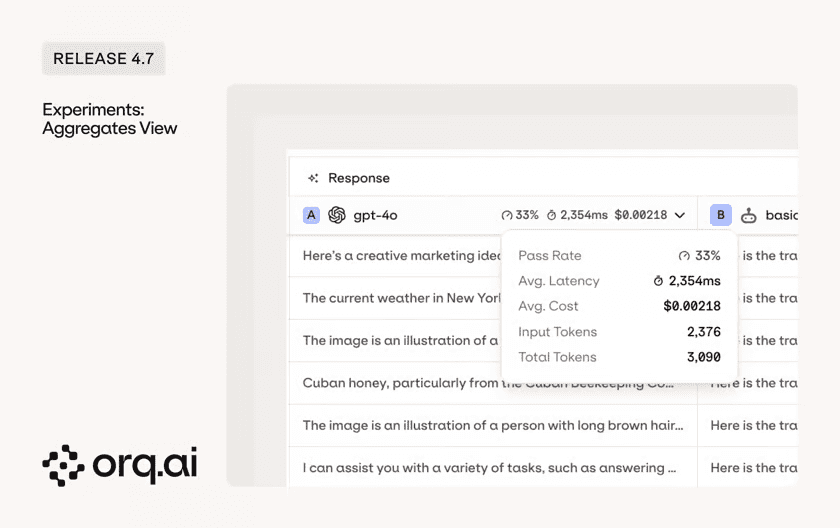
A cheaper route may weaken output quality. A model upgrade may help one workflow, and damage another.
Orq.ai connects routing with evaluations and observability so teams can measure those effects before they become defaults.
Choose for the stack you’re building toward
The easiest platform to adopt today may become difficult to operate after the workflow expands.
Test one likely future change against the architecture.
See how much code, configuration, and ownership would have to move.
Choose the platform that makes the next change easier to absorb.
Book a demo to see how Orq.ai helps engineering teams operate AI applications beyond model aggregation.