


An agent makes decisions before it writes an answer. Which team should handle a ticket? Does a message contain personal data? Should the next step use a tool or ask a person? These calls can carry sensitive information, and they happen throughout a workflow.
Orq now hosts Decider-4B in its own EU cluster. You can call it through the Decisions endpoint as orq/decider-4b.
What is a decision model?
A decision model gives you a direct way to make those calls. Supply an input and typed questions; get probabilities over the options you defined:
Yes/no: returns the probability that a statement holds.
Choice: returns a distribution over named alternatives.
Score: uses an ordered rubric.
The model reads the input and scores the answers in one forward pass, without generating a text response to parse.
Why self-host, and why Decider?
Routing and classification often need the user’s original message. Where inference happens matters just as much as where your application runs. Our Decider deployment keeps inference within Orq’s EU infrastructure: request data stays in the EU, and no third-party model provider receives it. Self-hosting also enables on-prem deployments, where the model runs in a customer’s infrastructure. Jev remains available through Orq, with inference hosted in the US. Developers can choose the deployment that fits their data requirements.

We chose Mapika’s Decider-4B for its compact size, support for long inputs and open licensing. It supports inputs of up to 32,000 tokens. Its Apache 2.0 license lets us run the model on our own infrastructure. Credit for building and releasing the model belongs to Mapika.
That capacity supports substantial documents, and its multilingual capabilities perform well in both English and Dutch. With 32k tokens, it boxes above it’s weight, beating Perplexity Decider and OpenJev by 4x and 2x, respectively.
How do decision models compare to LLMs?
We compared Decider and Jev, two dedicated decision models, with two general-purpose LLM configurations on five classification tasks. Normal GPT-5.6 Luna generates JSON answers with reasoning through the Responses API; GPT-6 Luna returns typed answers through the Decisions API. Both Luna entries are labelled LLM in the charts. All four configurations use the same task inputs and question definitions. Each task has 200 cases; typed decisions asks five related questions per case.

Jev leads on four tasks. Paired tests support its advantage on intent, typed decisions and PII after correcting across the five task comparisons. Decider’s numerical lead over Jev on Dutch intents is not statistically established here. These differences are specific to the cases measured.

For the four single-question tasks, Decider’s request p50 was 79–99 ms, against Jev’s 305–327 ms. Five-question typed-decision calls were 346 ms for Decider and 316 ms for Jev. Timing includes network and gateway time; cache state was not controlled. Speed depends on the workload.
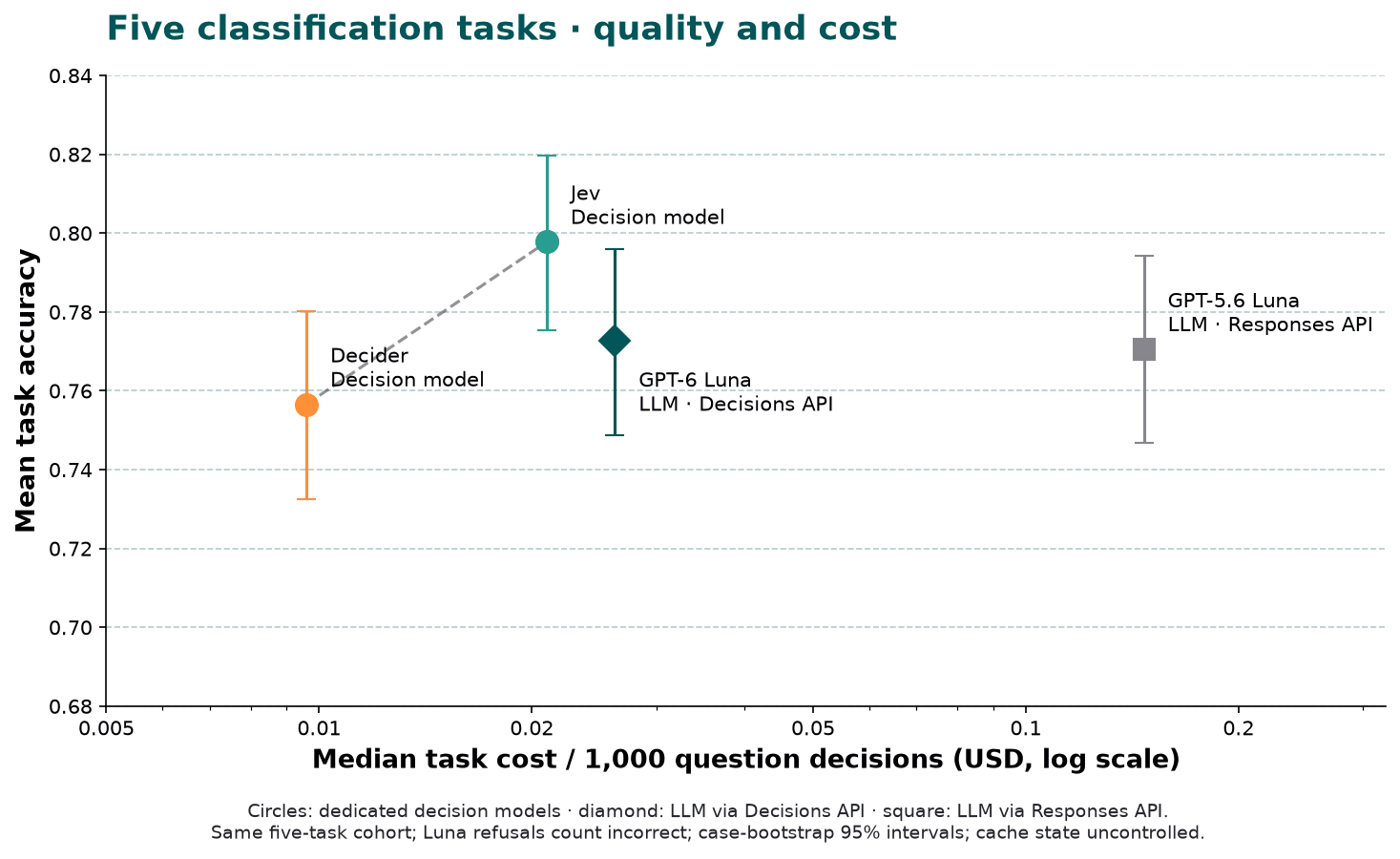
Orq’s model catalog lists Decider at $0.035 per million input tokens, compared with $0.042 for Jev and $0.10 for GPT-6 Luna. That is a 16.7% lower listed input price than Jev and 65.0% lower than Luna. The total cost per decision also depends on input length and the model’s reported token counts.
The measured median task cost per 1,000 question decisions was $0.0096 for Decider, $0.0210 for Jev, $0.0262 for GPT-6 Luna through the Decisions API and $0.1469 for normal GPT-5.6 Luna. Questions sharing a request share its cost. These figures combine recorded charges for Decider and both Luna configurations with Jev’s reported input tokens at the benchmark list rate.
Decider was 72.9% faster and 54.3% cheaper per decision than Jev in this benchmark. Against normal GPT-5.6 Luna, it was 93.0% faster and 93.5% cheaper per decision. Against GPT-6 Luna through the Decisions API, it was 60.8% faster and 63.4% cheaper per decision. Here, faster means lower request latency. These comparisons use the median task latency and measured cost across the five tasks, with costs measured per question decision.
Different reported token counts help explain the cost gap. In a separate live check, the identical two-question example reported 108 input tokens for Decider and 395 for Jev. We have not isolated how much comes from tokenization versus internal prompt/accounting rules.
Try it in your workspace
Enable the model for your project in Models, then start with a support-ticket route. This example asks for a department and whether the customer requests a refund in the same call:
The response contains answers.department.choice, its option probabilities, and answers.refund.noul. Our example call selected billing, with a reported billing probability of 0.9981 and refund probability of 0.9877. Treat these as one observed response, not guaranteed values. Make sure to select a confidence threshold tailored to your use case, so the model gives better answers.

Model Garden
Decider-4b is now available for 0.035$ per million input tokens, with no cost for output tokens. Ensure you enable the model before invoking it.

What’s next
Our ongoing evaluation tracks new models as they become available to determine what makes sense to offer through Orq, including smarter models and models that work with images, audio and other input types. We’re also expanding this work into best practices for using LLMs as judges of agent output.
For classification, tune the confidence threshold on labelled examples from your own workflow. Choose a threshold that balances missed cases against false positives, then check it on a separate set of examples. Route low-confidence cases to a person or another model, and monitor performance as your data changes.
Decider offers a clear price and speed advantage: 72.9% lower request latency and 54.3% lower measured decision cost than Jev across the five-task medians, with inference hosted in Orq’s EU infrastructure.
Choose orq/decider-4b in your workspace and send your first decision request.