






Changing an AI gateway rarely stays a gateway project.
Routing rules spread into application code. Keys build up around one control point. When its ownership or roadmap changes, the switching cost becomes architectural.
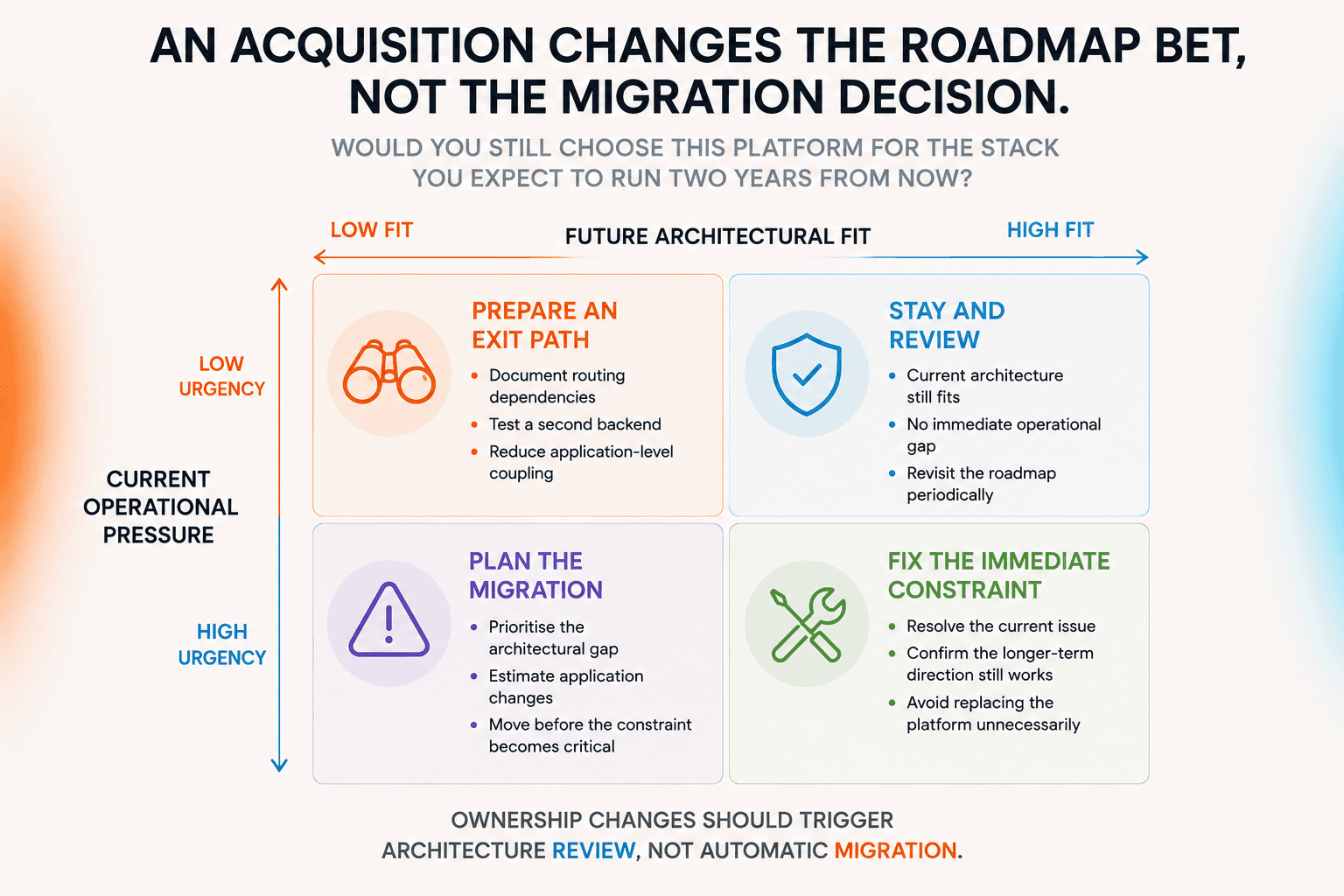
Portkey’s acquisition by Palo Alto Networks is a reason to reassess fit, not rush into a migration.
The real question is whether its future direction still matches your priorities.
Portkey’s acquisition changes the long-term roadmap bet
Palo Alto Networks brings deeper enterprise resources and a much larger security platform. Existing customers don’t need to migrate because ownership changed, though they should reconsider whether that direction still fits the architecture they expect to run in two years.
Would you still choose Portkey for the architecture you expect to run two years from now? And if the answer changes later, how much of your routing logic would have to move with it?
The best time to answer those questions is before switching becomes urgent.
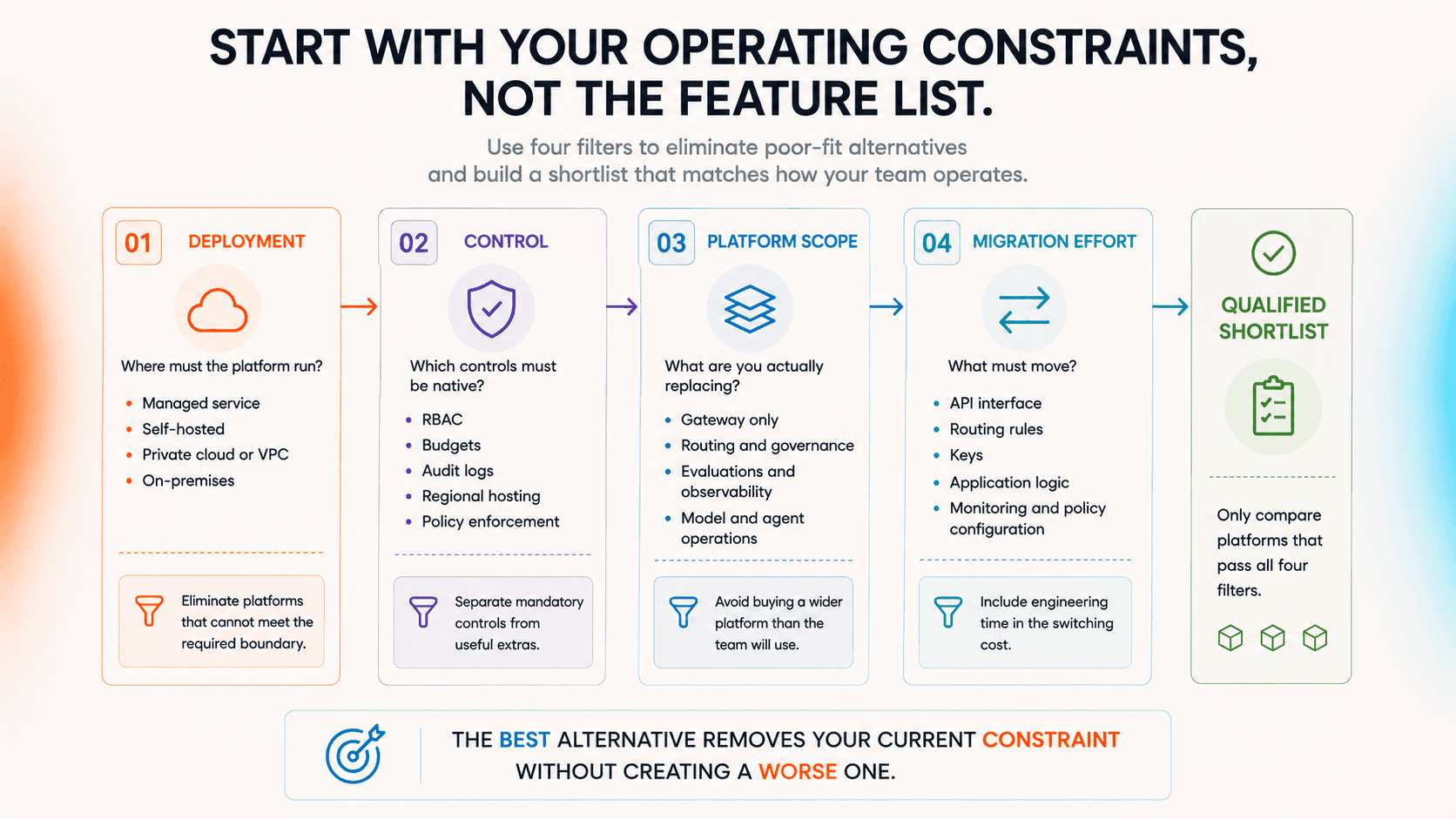
Choose based on deployment, control, platform scope, and migration effort
The best Portkey alternative is the one that removes your current constraint without creating a worse one.
A self-hosted gateway may offer maximum control then hand your platform team another service to scale.
Our view at Orq.ai is that deployment ownership is only one form of control. The more useful test is whether the team can change providers or routing policy without turning every decision into an infrastructure release.
A broader AI platform can consolidate more of the stack. That extra scope becomes overhead when routing is the only problem to solve.
The cheapest option on paper may also become expensive once infrastructure and engineering time are included.
Before comparing products, think about these four questions:
Deployment: Do you want a managed service, self-hosted software, or deployment inside your own cloud?
Control: Which capabilities must be native - RBAC, budgets, audit logs, regional hosting, or policy enforcement?
Platform scope: Are you replacing only the gateway? Or do you also need evaluations, observability, and agent operations?
Migration effort: Can you preserve your existing API interface and routing rules or will the move require application changes?
With those answers, you’ll be able to narrow the field quickly.
They also prevent a common mistake: choosing the platform with the longest feature list rather than the one that fits how the team operates.
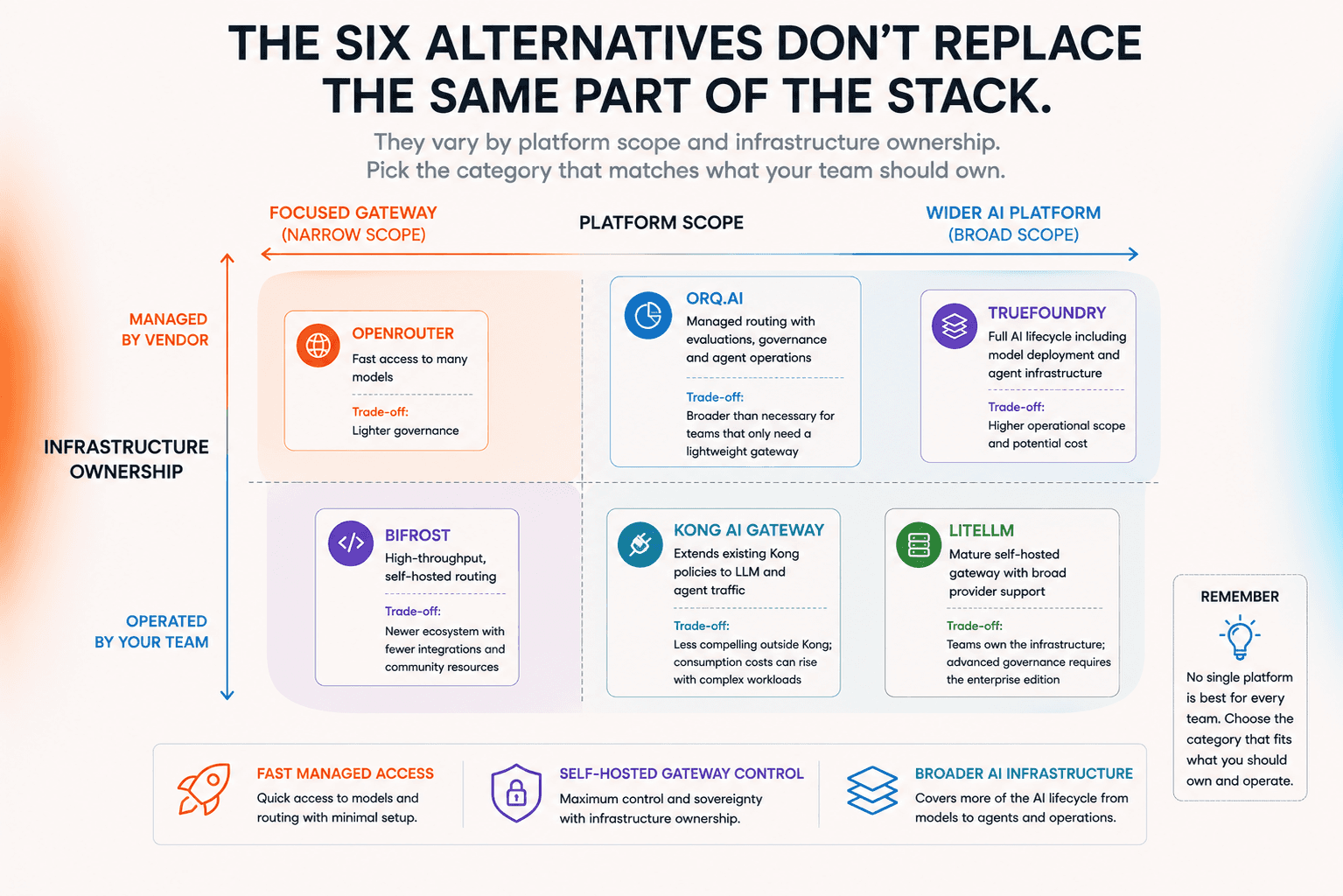
Portkey alternatives compared at a glance
No single platform is the strongest replacement for every Portkey user.
The true split is between managed platforms, self-hosted gateways, and broad model aggregators designed to fit an existing infrastructure stack.
Platform | Best for | Deployment model | Core strength | Main trade-off |
Orq.ai | Teams that want managed routing with evaluations and governance | Managed, with US or EU hosting | Connects routing, observability, evaluations, prompt management, and agent operations in one platform | Broader than necessary for teams that only need a lightweight gateway |
TrueFoundry | Enterprises deploying models, fine-tuning pipelines, and agents alongside gateway infrastructure | Managed, private cloud, VPC, or on-premises | Covers the wider AI lifecycle, including model hosting and Kubernetes-based deployment | Higher operational scope and potential cost than a gateway-only product |
Bifrost | Teams that want high-throughput, self-hosted routing | Self-hosted, open source | Go-based performance with governance capabilities available in the open-source version | Newer ecosystem with fewer integrations and community resources |
Kong AI Gateway | Platform teams already using Kong for API management | Managed or self-hosted within the Kong ecosystem | Extends existing Kong policies, plugins, and governance workflows to LLM and agent traffic | Less compelling outside Kong; consumption costs can rise with complex workloads |
OpenRouter | Teams that want broad model access with minimal setup | Managed | Fast access to hundreds of models and providers through one API | Lighter governance than enterprise-focused platforms, sustained usage introduces additional platform fees |
LiteLLM | Teams that want a mature, self-hosted open-source gateway | Self-hosted with a paid enterprise tier | Large provider ecosystem, OpenAI-compatible API | Teams own the infrastructure. Advanced governance requires the enterprise edition |
The best Portkey alternatives for different requirements
The shortlist only becomes useful when each platform is matched to the job it was built to do.
Below, the profiles focus on where each option fits and which trade-off comes with the choice.
1: Orq.ai - Best managed platform for routing, evaluations, and governance
Best for: Teams that want routing decisions connected to quality, cost, and governance rather than managed as a standalone gateway.
Routing decisions stay tied to quality
Orq.ai combines model routing with evaluations and tracing. Teams can see whether a cheaper route still meets the required quality threshold instead of judging the change from cost and latency alone.
We believe a routing decision is unfinished until its effect on the application has been evaluated. Lower cost proves that the route is cheaper. It doesn’t prove that the route is better.
Governance sits in the same control layer
Orq.ai applies access and budget policies at the same point where model traffic is routed. That keeps governance from becoming separate application logic that every team implements differently.
Our position is that policy should travel with model traffic. Once governance is added on after routing, exceptions begin accumulating inside individual applications.
The trade-off: more platform than some teams need
Orq.ai extends beyond gateway infrastructure into evaluations and observability.
Useful for enterprises operating several AI applications, but unnecessary for teams that only want a lightweight proxy.
2: TrueFoundry - Best for model deployment and full-stack AI infrastructure
Best for: Teams that want gateway capabilities inside a broader platform for deploying models and running AI infrastructure.
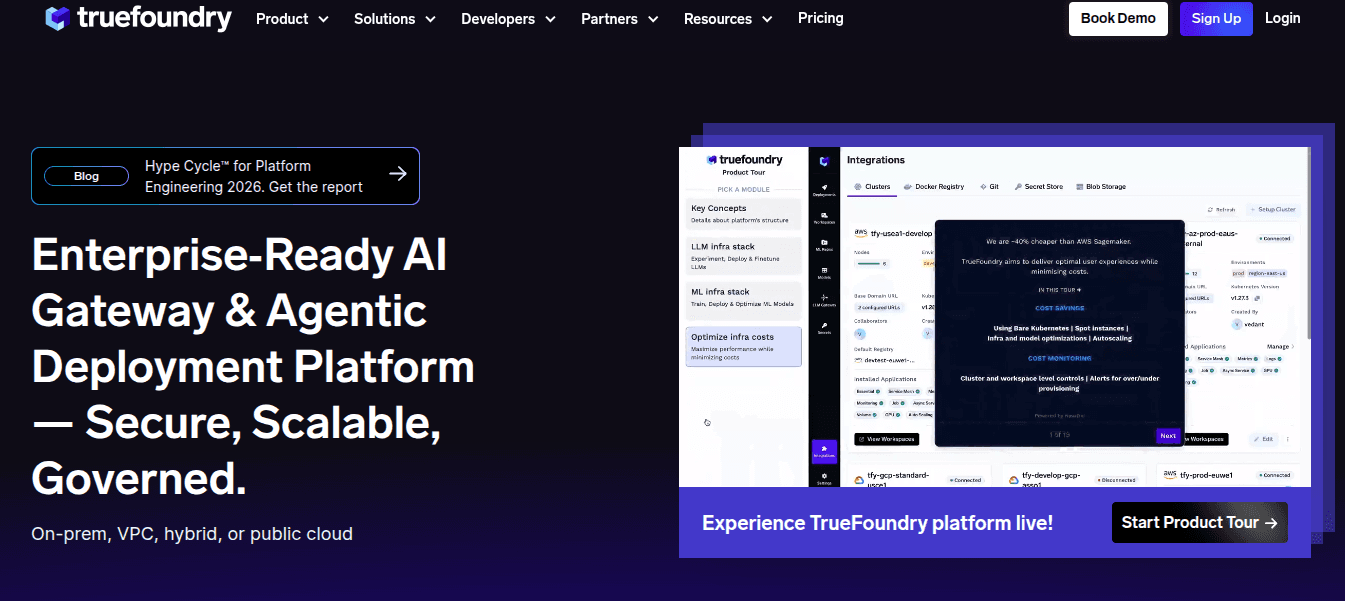
Gateway control extends into model operations
TrueFoundry started as an MLOps platform.
Routing, retries, and budget controls were added later.
That wider foundation makes it a stronger fit for teams managing both hosted models and third-party APIs.
The same control plane can support fine-tuning pipelines and MCP servers.
Enterprises working across traditional ML and generative AI can manage both without introducing a separate platform for every workload.
Kubernetes gives platform teams more deployment control
TrueFoundry runs on Kubernetes and supports private VPC and on-premises deployments.
That suits teams with strict infrastructure requirements or workloads that cannot pass through a shared managed service.
Its gateway is also designed for high request volumes and low overhead, which matters when routing sits in the critical path of several production applications.
The trade-off: broader scope brings more complexity
TrueFoundry asks teams to operate more than a gateway.
Kubernetes infrastructure and a wider platform surface all add cost and ownership.
For enterprises already managing that stack, the breadth can simplify operations. Teams that only need routing may find a narrower gateway easier to adopt.
3: Bifrost - Best for high-throughput self-hosted routing
Best for: Teams prioritizing low-overhead, self-hosted routing under high concurrency.

Built for throughput from the start
Bifrost is implemented in Go and designed around concurrent request handling with low gateway overhead.
Published benchmarks report roughly 11 microseconds at around 5,000 requests per second, though teams should reproduce those results under their own deployment conditions.
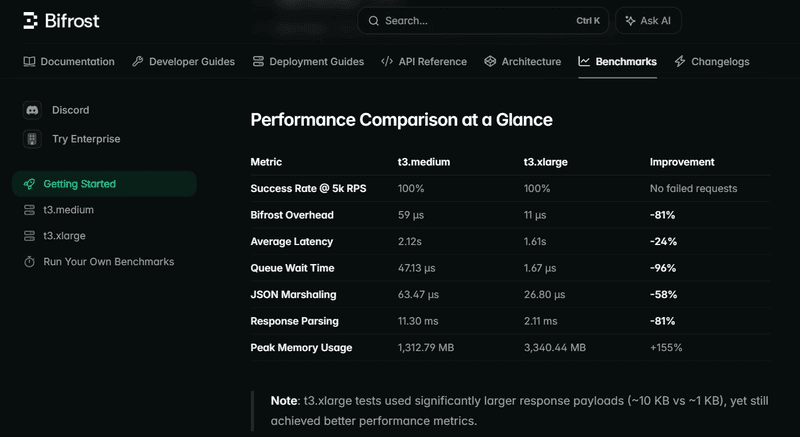
Several governance controls are available in the open-source edition
Bifrost is appealing to teams that want self-hosting and governance together, rather than starting with a free proxy and paying later for the controls production environments require.
The trade-off: a younger ecosystem
Bifrost hasn't had as long to build integrations, tutorials, and community knowledge as LiteLLM.
Hence, platform teams spend more time solving edge cases themselves.
For high-volume deployments, that can be an acceptable trade when predictable gateway performance matters more than ecosystem maturity.
4: Kong AI Gateway - Best for teams already running Kong
Best for: Platform teams that want to extend an existing Kong setup to LLM and agent traffic.

Reuse the control plane you already operate
Kong makes the most sense when its plugins are already embedded in your API stack.
Adding AI traffic to that environment is usually simpler than introducing a second gateway with its own policies and operating model.
We think continuity is an underrated selection criterion. A slightly narrower platform may create less risk when the team already understands how to deploy and support it.
The main advantage is continuity.
Existing teams can apply familiar controls to model providers without rebuilding governance from scratch.
AI traffic fits into Kong’s broader API model
Kong adds AI-specific capabilities such as semantic caching and prompt compression. Its Agent Gateway also extends policy enforcement to MCP servers and agent-to-agent traffic.
Useful for enterprises standardizing how both conventional APIs and AI workloads are governed.
The trade-off: pricing grows with platform usage
Kong is easiest to justify when the enterprise already operates its control plane.
For teams already committed to Kong, that may be acceptable. Outside its ecosystem, a purpose-built AI gateway can be easier to justify.
5: OpenRouter - Best for fast access to a broad LLM catalog
Best for: Teams that want to test and switch between a large number of models without operating gateway infrastructure themselves.
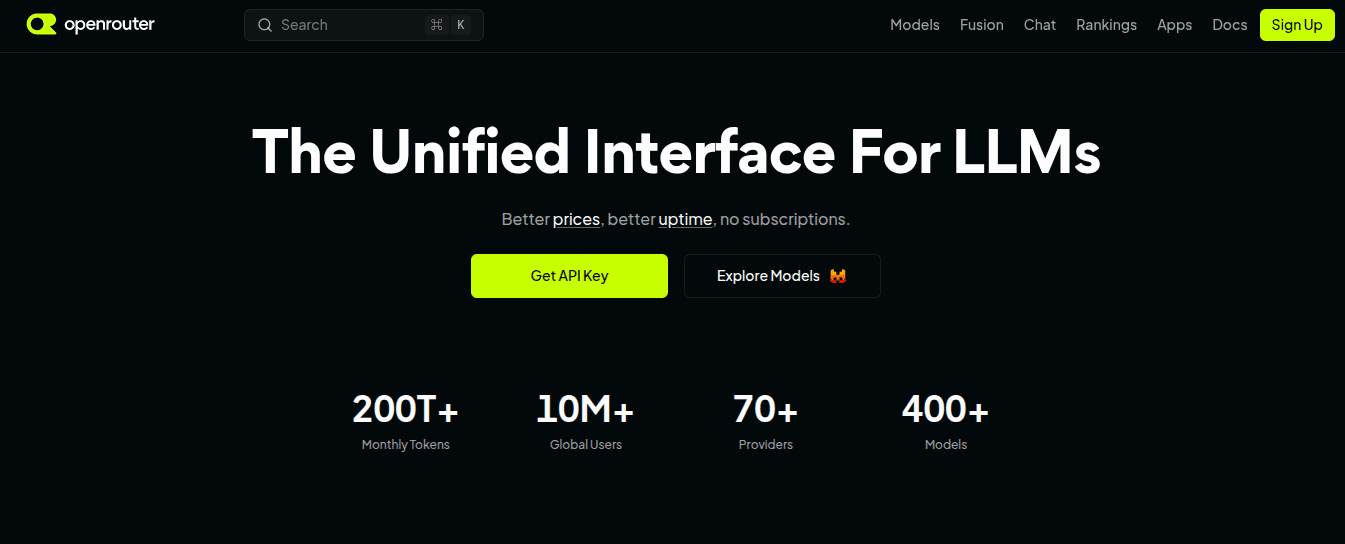
One API opens access to hundreds of models
OpenRouter gives developers a single interface for more than 400 models across 70+ providers. Teams can compare frontier and open-source options without building a separate integration for each vendor.
That makes it very useful for prototyping and model evaluation. A new model can be tested against existing workloads quickly, while provider changes stay outside the core application.
Minimal setup keeps experimentation moving
There’s no gateway service to deploy or maintain. OpenRouter handles provider access behind the API. Small teams can start quickly and larger teams can explore new models without waiting for platform engineering work.
The trade-off: convenience comes with fees and lighter governance
OpenRouter charges a platform fee on credit purchases, with additional fees for BYOK traffic beyond the included allowance. Those costs can become meaningful at sustained production volume.
Enterprise controls are also lighter than those offered by platforms centred on governance.
Teams that need granular RBAC or formal uptime commitments may need to add another control layer or negotiate those requirements separately.
6: LiteLLM - Best mature open-source option for self-hosting
Best for: Teams that want a proven self-hosted gateway with broad provider support and an OpenAI-compatible interface.
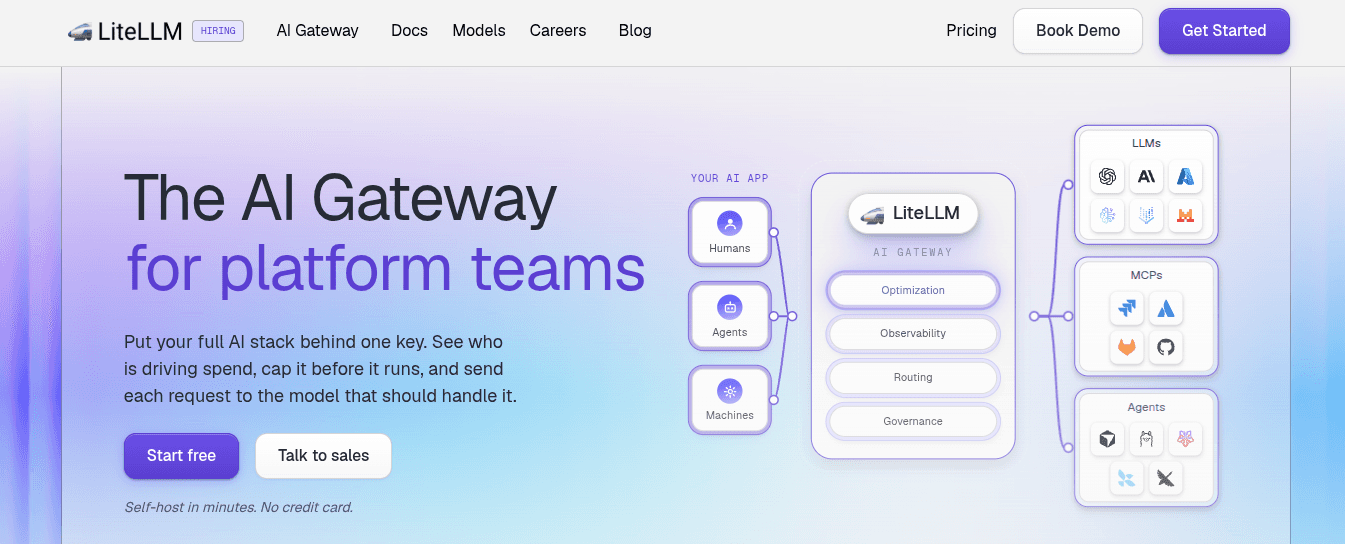
A mature ecosystem lowers adoption risk
LiteLLM supports more than 100 providers behind one API and has years of community usage behind it. That makes common integrations easier to find and operational issues less likely to be completely undocumented.
For teams comfortable managing infrastructure, it offers a practical route to provider abstraction without committing to a managed gateway.
The open-source edition covers the core gateway layer
LiteLLM handles unified model access and can run on infrastructure your team controls.
You keep ownership of deployment, scaling, and data flow while preserving a consistent interface across providers.
That control is particularly useful when self-hosting is a requirement rather than a preference.
The trade-off: some team controls require the enterprise tier
The open-source edition covers the core gateway layer. Capabilities such as SSO and team-level budget management may require LiteLLM Enterprise, so teams should compare the free and paid boundaries against their governance requirements.
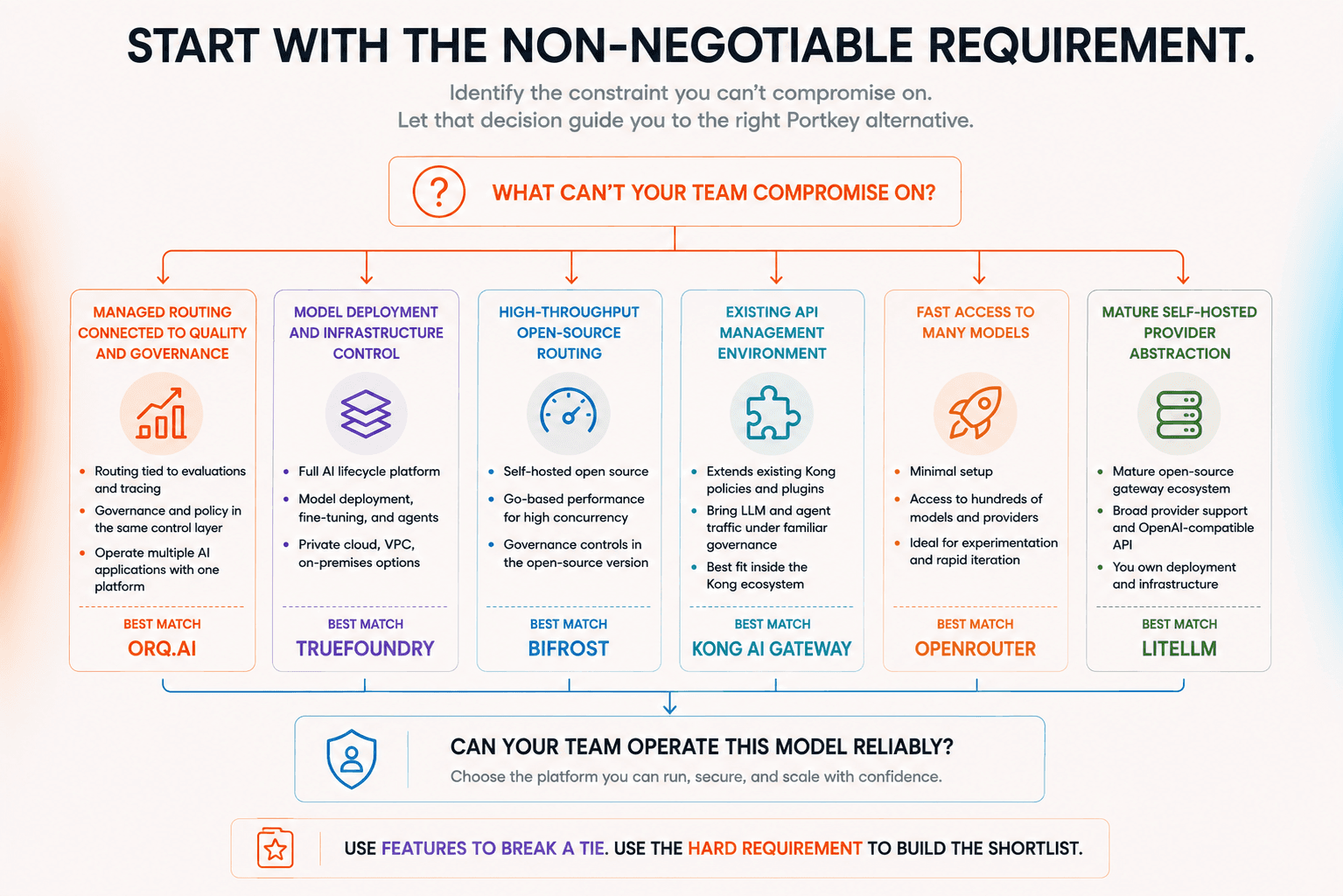
Match each platform to the constraint you cannot compromise on
Choose around the requirement that cannot be delegated.
If deployment control is non-negotiable, start with the self-hosted options. If the gateway must sit inside an existing infrastructure platform, evaluate Kong or TrueFoundry in that context. If teams need managed routing tied to application quality, Orq.ai is the stronger fit.
When two products satisfy the hard requirement, choose the one that creates the lower operating burden.
Choose for the architecture you expect to operate in two years
You usually learn how portable a gateway is when you try to leave it.
Test that before you commit. Take one representative workflow, recreate its routing policy against a second backend, and record how much application logic has to move with it.
A painful exit drill in staging will only get worse once the gateway sits beneath several production applications.
Orq.ai connects managed routing with evaluations and governance while keeping model choice flexible.
Run your own traffic through Orq.ai and see how the fit holds up in practice.